
The Special Prosecutor Who Wants to Hire Another Prosecutor
Media Metadata
New York's increasingly controversial investigation into the sexual-assault allegations involving Cornell University has taken another unexpected turn.
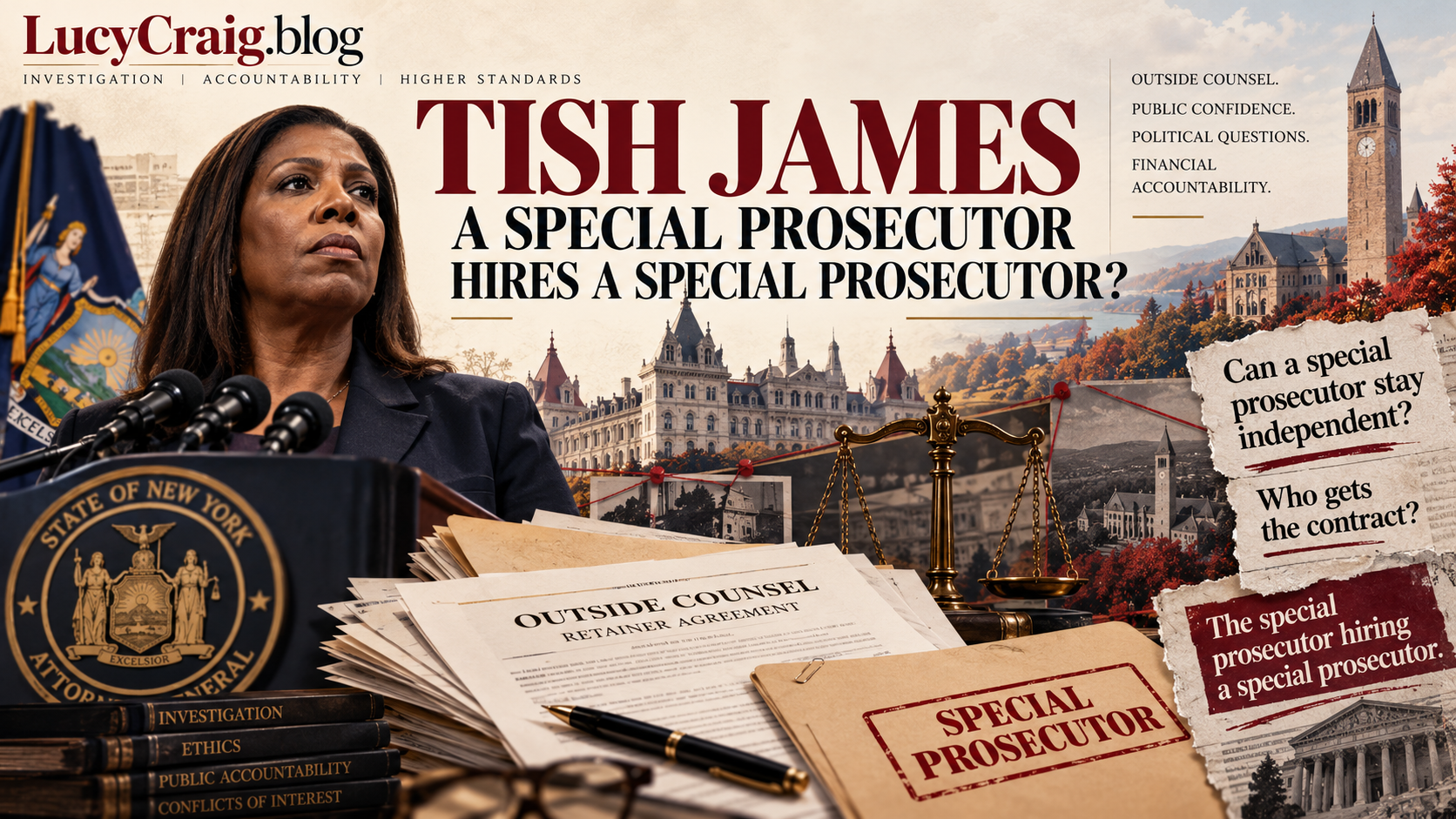
Attorney General Letitia “Tish” James, appointed by Governor Kathy Hochul as special prosecutor on October 1, 2026, is seeking outside legal counsel to assist with the investigation.
Yes. The state appointed a special prosecutor, and the special prosecutor is now looking for outside prosecutors.
The irony deserves attention.
According to an October 24 report by the New York Post, James's office has already interviewed several former federal prosecutors. Sources identified former federal prosecutor Maggie Gandy as a possible candidate.
But James's spokesperson, Alexis Richards, disputed the newspaper's reporting about Gandy specifically, saying she had not heard of Gandy being considered.
No completed hiring agreement has been publicly established in the reporting reviewed.
There is an important legal distinction, too: James would not necessarily be appointing another independent special prosecutor. Her office describes the outside attorneys as counsel who would support an investigation still led by its Criminal Justice Division.
That distinction goes straight to the heart of the controversy.
If James retains ultimate supervisory authority, how independent is the person she selects?
And if an outside lawyer truly exercises independent prosecutorial judgment, what safeguards ensure that independence is more than a public-relations promise?
These are not trivial questions.
They concern an investigation involving seven men who deny allegations of sexual assault, a plaintiff whose claims have generated national attention, and a state government that has already faced legal challenges over its choice of prosecutor.
I. September 28: James Speaks Before She Becomes Special Prosecutor
The questions about James's impartiality did not originate with the proposed outside-counsel arrangement.
They began before she received the appointment.
On September 28, James publicly commented on the allegations made by Lucy Craig, the plaintiff identified as Jane Doe in court.
Writing on social media, James described what the young woman had reportedly endured as “horrific and unacceptable.”
Her post also expressed personal sympathy and solidarity with sexual-assault survivors.
Those words may be entirely understandable expressions of compassion.
But three days later, Governor Hochul placed James in a fundamentally different position.
She was no longer simply an elected official commenting on a matter of public concern.
She was the person assigned to direct a criminal investigation of the allegations.
And prosecutors are not supposed to decide whether a particular person's conduct constitutes a crime based on the intensity of public sympathy, the popularity of an accusation, or the political reaction surrounding a civil lawsuit.
Their responsibility is to examine evidence, consider contrary information, identify exculpatory material, evaluate individual responsibility, and determine whether the law supports criminal charges.
This distinction forms the basis of the challenge raised by Andrew Miltenberg, an attorney representing one of the accused men, Gillio Lopes.
Miltenberg argues that James's public comments could reasonably be interpreted as accepting that the alleged events occurred before she had independently reviewed the evidence.
That is an argument about the appearance of prejudgment, not proof that James has actually prejudged the investigation.
James and her office reject the suggestion that expressing empathy renders her incapable of carrying out a fair investigation.
The question is whether an official's public statements, considered in context, create a legally significant conflict or risk of prejudice.
A prosecutor may express concern for a complainant while remaining legally obligated to presume the accused innocent. The difficult question is where sympathy ends and prejudgment begins.
II. Governor Hochul's Executive Order: Replacing One Prosecutor to Restore Public Confidence
On October 1, Governor Hochul signed Executive Order No. 64, removing responsibility for the specified criminal matter from the Tompkins County district attorney and assigning it to the attorney general.
Hochul cited concerns about the original investigation, including reports that the district attorney had not personally interviewed Lucy Craig before declining prosecution in 2024.
The order stated that the public interest required an objective review.
This creates a significant institutional question.
The governor invoked concerns about confidence in the local prosecutor's investigation to justify transferring prosecutorial authority.
Yet the replacement prosecutor had already made public comments that prompted a separate set of impartiality objections.
The legal debate is not resolved merely by pointing out that sequence. Public empathy is not equivalent to a disqualifying conflict of interest, and the original investigation may have had legitimate deficiencies requiring independent examination.
Nevertheless, the sequence warrants scrutiny because the stated purpose of the transfer was to restore confidence in the criminal process.
If a replacement prosecutor's appointment immediately generates a new recusal dispute, has the transfer fully accomplished that objective?
Governor Hochul's order explicitly authorizes the special prosecutor or her designee to carry out investigative and prosecutorial duties.
That means delegation is contemplated in the original legal instrument.
But delegation is not necessarily institutional separation.
A lawyer assisting James's office may remain subject to the office's supervision, personnel decisions, and strategic direction.
If the purpose of outside counsel is to respond to concerns about James herself, the public needs to know the limits of that lawyer's independence.
Media Metadata
III. The Legal Challenge Is Already in Court
The question is no longer confined to press interviews and social-media arguments.
On October 7, attorneys for Gillio Lopes filed a proceeding challenging James's appointment.
The petition argues that her prior statements created concerns about impartiality.
The state responded on October 22, asking an Albany court to dismiss the challenge.
Attorneys representing Hochul and James argued that the petition was premature, procedurally deficient, and unsupported by facts establishing a disqualifying conflict.
They also contended that the social-media statements reflected empathy rather than a determination of guilt.
No charges had been filed as of the latest reporting reviewed.
The legal distinction matters.
New York courts generally require substantial grounds before disqualifying a public prosecutor at the request of an adverse party.
Disagreement with a prosecutor's statements or political identity does not automatically satisfy that standard.
The relevant standards discussed in Matter of Working Families Party v. Fisher and People v. Zimmer address demonstrated conflicts, actual prejudice, and substantial risks affecting prosecutorial fairness.
In Matter of Pinney v. Van Houten (2019), the Appellate Division also recognized that a prosecutor may voluntarily seek replacement where reasonable concerns about the appearance of impropriety justify stepping aside.
Remarkably, that earlier decision involved the same Tompkins County district attorney, Matthew Van Houten, although the underlying facts were different.
These authorities do not establish that James is legally disqualified.
They do establish that prosecutorial independence and confidence in the fairness of proceedings are recognized judicial concerns.
Whether James's particular statements meet the applicable standard remains a matter for the court.
IV. Maggie Gandy, Corva Law, and the Question of Who Gets the Contract
The New York Post identified Margaret “Maggie” Gandy as one possible outside-counsel candidate.
Gandy is a partner at Corva Law LLP.
According to her firm's biography, she previously served as deputy chief of the Organized Crime and Gang Section in the United States Attorney's Office for the Eastern District of New York.
She has substantial experience involving criminal prosecutions, internal investigations, sexual-misconduct matters, and institutional compliance.
Those credentials are relevant to an inquiry involving allegations of sexual violence and a university's response.
But the Post's unnamed sources and the attorney general's spokesperson gave conflicting accounts about whether Gandy was actually being considered.
No engagement of Gandy or Corva Law has been established.
Nor has evidence been identified showing that Gandy or her firm has an undisclosed personal, romantic, or financial relationship with James.
It would be irresponsible to imply such a relationship without documentation.
However, the possibility of retaining private counsel raises questions that apply to any firm selected.
Who identifies the candidates?
Who evaluates their qualifications?
Who approves compensation?
Must applicants disclose campaign contributions, political relationships, prior business dealings, or other potential conflicts involving the appointing officials?
Will the engagement be awarded through a competitive process, or pursuant to an exception?
Can the retained attorney recommend declining prosecution without interference?
And who has the authority to terminate the engagement?
These are the appropriate questions when prosecutorial work may be assigned to privately compensated lawyers.
Independence should be demonstrated through the terms of the appointment, not merely announced in a press release.
V. James Has Hired Outside Investigators Before — At a Cost Exceeding $3.5 Million
Here is a more directly relevant precedent than any controversy involving another state's prosecutor.
In March 2021, Letitia James announced the appointment of two outside attorneys to lead an investigation into sexual-harassment allegations against then-Governor Andrew Cuomo.
The appointees were former acting United States Attorney Joon H. Kim and employment attorney Anne L. Clark.
Their firms, Cleary Gottlieb Steen & Hamilton and Vladeck, Raskin & Clark, received substantial state contracts.
According to Reuters, New York agreed to pay more than $3.5 million for the firms' work.
The reported amounts included approximately $2.552 million for Cleary and $950,000 for the Vladeck firm.
That investigation ultimately produced findings adverse to Cuomo, who disputed the conclusions.
The point is not that James improperly selected the investigators. The investigation was authorized, and the attorneys brought substantial professional credentials.
Nor is there evidence in that reporting that either firm received the work because of an inappropriate personal relationship.
The point is that James's office has previously used a model in which private law firms are selected and compensated to undertake high-profile investigations.
And the fees were substantial.
The Cornell investigation therefore presents concrete financial-accountability questions.
Will outside counsel bill by the hour?
Will there be a maximum contract value?
Will investigators, associates, document reviewers, and experts be billed separately?
Will the public have access to the final agreement and expenditure records, subject to lawful exemptions?
Who will determine whether the work and associated charges are reasonable?
Under Executive Law § 63(2), expenses of prosecutions conducted under a gubernatorial superseder are designated as county charges. Whether and how any particular Cornell outside-counsel costs would be charged requires examination of the eventual engagement and applicable funding arrangements.
No verified Cornell contract amount has yet emerged from the reporting reviewed.
The Cuomo precedent does not tell us what this investigation will cost.
It does demonstrate why the public should insist on documentation before accepting vague assurances about outside counsel.
VI. Outside Counsel Could Improve the Investigation — But That Is Not Automatic
Not every observer considers the decision to involve outside counsel problematic.
In the October 24 Post report, civil-rights attorney Norman Siegel described independent outside assistance as a prudent response to concerns surrounding the high-profile investigation.
Former Queens prosecutor James Quinn disagreed with the original decision to appoint James, but also identified retaining an outside lawyer as a possible response to the controversy.
Those positions illustrate two different questions.
The first is whether independent counsel could bring useful expertise and additional protection against biased decision-making.
The second is whether merely retaining counsel removes any alleged defect in the appointment of the supervising prosecutor.
It is entirely possible for outside prosecutors to improve a complex investigation.
Experienced lawyers can conduct interviews, examine forensic evidence, review earlier investigative decisions, and provide perspectives that internal personnel may not possess.
But the mere presence of outside lawyers does not answer questions about ultimate authority.
A retained attorney could operate with considerable professional independence.
Alternatively, the lawyer could act primarily as an adviser whose recommendations remain subject to approval by the very office whose impartiality has been challenged.
Those arrangements are not equivalent.
Until an engagement agreement establishes the lawyer's actual responsibilities, the distinction remains unresolved.
VII. What About Lucy Craig and the Seven Accused Men?
The underlying allegations must not disappear beneath a political and procedural dispute.
Lucy Craig alleges that she was sexually assaulted at Cornell in October 2024.
The seven accused men have denied wrongdoing.
The university has disputed allegations concerning its handling of the matter while acknowledging that its procedures warrant examination.
A criminal investigation must consider the complainant's account seriously and examine relevant evidence thoroughly.
It must also examine statements and evidence that may contradict the allegations.
Investigators must assess the conduct allegedly attributable to each person individually.
A civil complaint is not a criminal conviction.
Public support for a complainant is not a substitute for proof.
Neither is a decision by an earlier prosecutor to decline charges necessarily conclusive proof that no criminal conduct occurred.
Those principles are compatible.
A legitimate investigation does not need to begin with either a presumption that Craig fabricated her allegations or an assumption that the accused men committed the alleged offenses.
It needs to begin with the evidence.
That is the standard Governor Hochul invoked when transferring the matter to the attorney general.
It is also the standard against which the investigation and any outside-counsel arrangement can reasonably be evaluated.
VII. The Questions That Remain Unanswered
The public record as of October 25 leaves several material questions unresolved.
The appointment: What authority will any outside attorney exercise under Executive Order No. 64, and what decisions will remain with James or her senior staff?
The selection: Who will choose outside counsel, and what conflict-screening and procurement procedures will govern the appointment?
The compensation: What are the proposed rates, anticipated expenditures, funding sources, and maximum financial commitments?
The independence: Can the outside attorney make an independent recommendation not to charge a suspect, and what happens if James disagrees?
The disclosures: Will records identifying the selected firm, material relationships, and the engagement's governing terms be publicly released to the extent legally permissible?
The investigation itself: Will the retained lawyers examine potentially exculpatory evidence and any shortcomings in the original investigation with equal rigor?
These questions can be answered without compromising witness privacy, protected investigative material, or legitimate law-enforcement interests.
And none requires anyone to presume corruption.
They require public officials to explain how delegated prosecutorial power will actually be exercised.
IX. An Investigation About Public Confidence Must Earn Public Confidence
New York's Cornell controversy has now generated several overlapping questions about investigative independence.
The original district attorney's handling of the matter came under criticism.
The governor transferred responsibility to the attorney general.
The attorney general's earlier public comments then became the subject of a legal challenge.
And her office is now considering outside lawyers to assist with the investigation.
Each development may have an individually defensible explanation.
The original inquiry may have been incomplete.
The governor may have possessed lawful and substantial reasons to invoke her superseder authority.
James's statements may have reflected compassion rather than prejudgment.
Outside attorneys may supply important experience and additional independence.
But those explanations are not established merely by repeating the words fairness, confidence, and independence.
The relevant appointments, legal authorities, decision-making structures, and financial arrangements should be examined on their own terms.
The actual question is not whether a special prosecutor may employ additional attorneys. The governor's order expressly contemplates action through a designee.
It is whether the public can determine who is responsible for the investigation, who controls the outcome, who receives payment, and what safeguards protect every participant from biased decision-making.
If outside counsel is truly intended to strengthen public confidence, the arrangement should be structured so that its independence can be evaluated rather than simply assumed.
That expectation applies equally to the treatment of Lucy Craig and to the rights of each accused man.
In a case already dominated by national publicity, public officials have an opportunity to show how prosecutorial independence works in practice.
-Chief Justice William Rehnquist, majority opinion, 485 U.S. at 55.