Dear Judge Perry-Bond: A Privacy Request Is Not a Delete Key.
An apparent DeleteMe legal submission. A federal judicial-security law that doesn't appear to fit. A demand to remove an entire public-interest article. And WIJDR's response: not on this record.
Well, well, well. WIJDR has received a removal demand that seems to believe an intimidating statutory title and a 72-hour clock should do the work of an actual legal argument.
On October 22, 2026, a submission arrived through our legal-submission portal, claiming to come from the data-removal company DeleteMe on behalf of New York State Supreme Court Justice Phaedra F. Perry-Bond. It invokes the federal Daniel Anderl Judicial Security and Privacy Act, references possible action involving federal authorities, and seeks removal of our article about the judge.
We have not independently authenticated the sender's identity or the judge's claimed authorization. For purposes of assessing the request, we will assume its representation is genuine. That assumption does not cure what the submission fails to explain.
Exhibits: What WIJDR Received
Readers can examine the original screenshots for themselves. The removal request is a legal-submission record; the other image documents the public homepage of the company named in it.
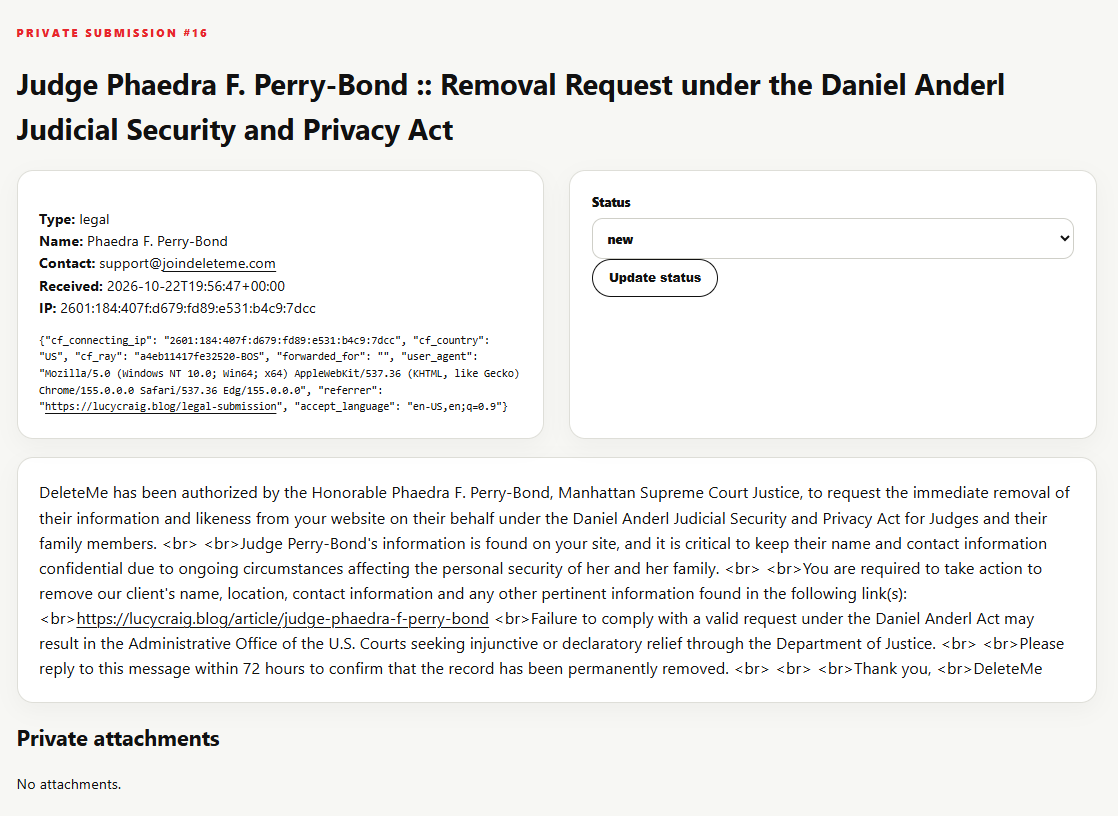
Media record 590 · Original image

Media record 589 · Original image
The first screenshot includes administrative technical data. Those details do not establish authorship and should not be used to identify or contact a purported sender.
Problem One: Citing the Wrong Federal Judicial Category
The letter invokes the Daniel Anderl Judicial Security and Privacy Act of 2022. That important federal legislation was enacted following the killing of Daniel Anderl, the son of federal Judge Esther Salas. Its protections address the security and personal information of federal judicial officers and covered family members.
Justice Perry-Bond holds office in the New York State judiciary. Despite the court's title, the Supreme Court of the State of New York is a state trial court, not the United States Supreme Court. The submission does not establish why the federal Act covers her.
The letter's reference to federal enforcement channels does not substitute for identifying an applicable law, a protected category of information, and a valid route to relief. A legal claim requires more than a commanding tone.
Problem Two: New York Has a Judicial Security Law — And It Matters
There is a real New York judicial-security statute. New York Judiciary Law § 859 provides protections for qualifying state and federal judges and specified private information. It establishes detailed procedures, including employer-mediated notice for certain demands and a 72-hour period following qualifying notification.
It also expressly recognizes exceptions for information relevant to news stories, commentary, editorials, and other speech on matters of public concern; information voluntarily disclosed by the eligible individual; and information received from government agencies, among other exceptions.
The submission did not invoke this New York statute or show compliance with its relevant procedures. Nor did it point to a specific protected detail in our article and explain why that material falls outside the public-concern protections.
That does not mean no valid privacy request could ever be made. It means the demand for blanket deletion is not adequately substantiated by the message sent to us.
Problem Three: No Specific Violation, Just “Remove It”
The submission identifies the article URL but does not meaningfully distinguish public judicial biography and criticism from legally protected private personal information. That distinction matters. A judge's private residential information and a judge's official decisions are not interchangeable.
WIJDR can assess a properly particularized complaint about sensitive information, factual error, or legal restriction. A demand to remove an entire article about a public official, however, requires a substantially better explanation.
The Public Record: Who Is Phaedra Fane Perry?
Public professional and governmental records provide a starting point for evaluating judicial accountability. The following information concerns professional qualifications, employment, public compensation, and election participation — not a private residence or family.
Attorney Registration and Professional Credentials
| Registered name | Phaedra Fane Perry |
| Registration | 4155164 |
| Year admitted | 2003 |
| Law school | University of Wisconsin Law School |
| Listed status | Currently registered |
| Next registration | August 2027 |
| Recorded employer | NYC Civil Court |
| Professional office | 111 Centre Street, Manhattan, New York |
| County | New York |
Source: OpenGovNY attorney record 4155164. The historical entries include 2021 and 2026 updates to courthouse-office registration information. The employer label may be a historical administrative entry rather than the full current assignment.
Public Employment and Compensation
OpenPayrolls associates Phaedra F. Perry with successive New York judicial positions, including Civil Court and Supreme Court service. Public compensation is a legitimate transparency subject; a payroll entry alone says nothing about the quality or integrity of judicial decisions.
| Year | Reported position | Reported pay |
|---|---|---|
| 2021 | Civil Court Judge | See source profile |
| 2022 | Supreme Court Justice | $210,900 |
| 2023 | Supreme Court Justice, District 1 | $210,900 |
| 2024 | Supreme Court Justice, District 1 | $227,441.80 total pay |
| 2025 | Supreme Court Justice, District 1 | $232,600 |
Source: OpenPayrolls profile. Its 2024 annual pay rate is shown as $232,600, distinct from that year's reported total pay. These are third-party presentations of government data.
Judicial Elections and Campaign Finance
A Transparency USA candidate profile identifies the 2023 Supreme Court election, Democratic Party affiliation, and committees named Phaedra Perry for Civil Court and Phaedra Perry for Supreme Court.
The source's 2024-cycle summary reports $8,440 in contributions and $11,587 in expenditures. These are reporting-cycle figures, not necessarily lifetime totals. It also lists a $1,500 contributor amount from Block O'Toole & Murphy LLP, which by itself is not evidence of favoritism or impropriety.
| Filer name | Phaedra F. Perry |
| Filer identifier | C06162 |
| Filer designation | Candidate |
| Office category | Civil Court Judge |
| Listed treasurer | Phaedra Perry |
| Filer status | Inactive (specific election filer only) |
Source: OpenGovNY C06162. See also the New York State Board of Elections reporting system. Inactive filer status is not inactive judicial employment.
None of these disclosed qualifications, appointments, pay figures, or campaign records establishes wrongdoing. Their significance is straightforward: a judge exercises public authority, and citizens can scrutinize the public record of that authority.
A Public Official Is Open to Public Criticism
Justice Perry-Bond presides over litigation involving Cornell University that has generated public discussion. Judicial independence and judicial security are essential. So is the public's ability to scrutinize proceedings, court rulings, judicial elections, and official conduct.
Criticism may be sharp. It may be sarcastic. It may upset the official being criticized. None of that alone makes public-interest speech a security violation.
Equally, criticism is not permission to publish genuinely protected private information, threaten an official, or disregard a valid order. The distinction is not difficult, and WIJDR expects anyone demanding deletion to explain where the line was crossed.
The Last Word
If the sender has identified a legitimate privacy concern, provide the legal authority and the precise passage. WIJDR can consider it. If the sender simply dislikes criticism of a public official, that is not a legal argument. It is a preference — and a rather expensive-sounding one when wrapped in references to federal enforcement.
We are not going to confuse a request with a court order, public office with private immunity, or a statutory citation with proof of a violation.
Request for blanket deletion: rejected as submitted.
Our reporting remains published. The public-record sources remain available. We invite corrections supported by evidence and privacy concerns supported by law.
The First Amendment is not a setting on a reputation-management dashboard.
— The Editors, LucyCraig.blog
Sources and Documents
- WIJDR — purported legal submission, exhibit 590 (original)
- WIJDR — DeleteMe homepage, exhibit 589 (original)
- Original WIJDR article
- Federal Daniel Anderl Judicial Security and Privacy Act, statutory notes
- New York Judiciary Law §859, New York State Judicial Security Act
- Attorney registration 4155164
- OpenPayrolls judicial-employment profile
- Transparency USA campaign summary
- Candidate filer C06162
- NY Board of Elections public reporting
Editorial verification: Authentication of the legal-submission sender and authorization remains outstanding. Public compensation and election figures may be historical or incomplete and should be reconciled against primary records if contested. Nothing in this article establishes bad faith, improper influence, impersonation, or wrongdoing by any named individual. This piece addresses an asserted legal demand and public affairs, not any person's residential whereabouts or private family security information.