
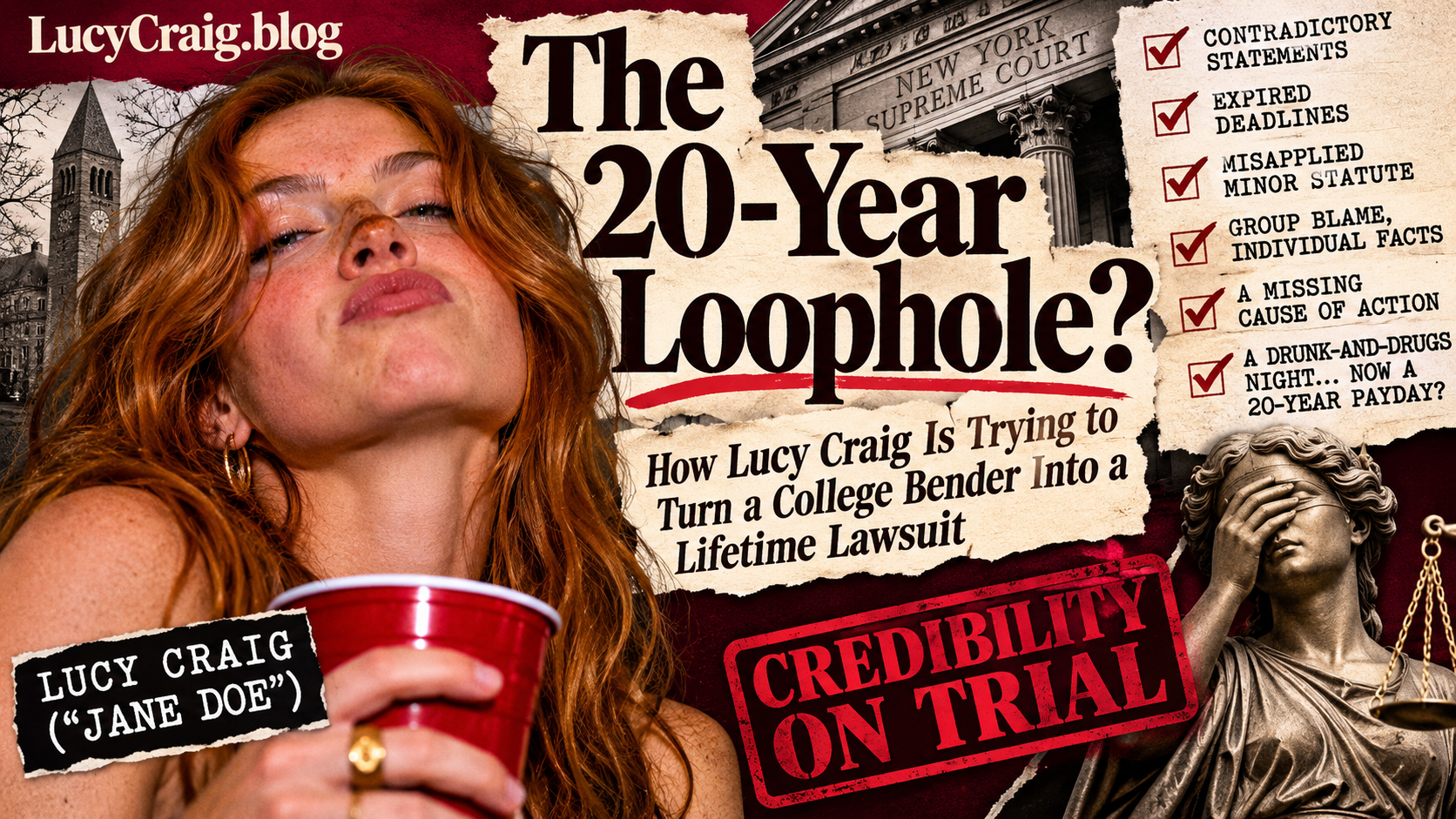
Two recent court decisions, an expired ordinary filing deadline, questionable reliance on criminal statutes, and a conspicuously missing fifth cause of action raise uncomfortable questions about the legal architecture of Lucile H. Craig's civil lawsuit.
Media Metadata
An accusation is not a conviction. A criminal statute is not automatically a civil cause of action. And a 20-year statute of limitations is not a legal permission slip to sue anyone whose name appears in the same room.
Those distinctions matter in the civil lawsuit filed by Lucile H. Craig (Lucy Craig), the plaintiff proceeding as Jane Doe against Cornell University, seven former fraternity members, and several institutional defendants.
The alleged events occurred October 19–20, 2024. Craig commenced her civil action on September 16, 2026, approximately 23 months later.
Under New York's ordinary rules, intentional assault and battery claims generally must be filed within one year. That deadline had already passed.
Craig's attorneys nevertheless assert sexual assault, sexual battery, and intentional infliction of emotional distress claims against seven named men: Matthew Ingalls, Johnathan Newell, Winston Lee, Gillio Lopes, Diego Sarabia, Scott Norris, and Scott Kretzschmar.
Their apparent solution is New York Civil Practice Law and Rules § 213-c, a statute providing a 20-year filing period for civil injuries arising from specifically enumerated sexual offenses.
That statute can be powerful. It can protect legitimate claims brought years after an alleged sexual offense, and it does not require criminal charges or a conviction.
But it is not unlimited, and New York's courts have made that increasingly clear.
1. The July 2026 appellate decision Craig's lawyers should study carefully
On July 24, 2026, the New York Appellate Division, Fourth Department, issued a significant decision in Gianna T.D. v. 64 W. Chippewa Associates LLC, 2026 NY Slip Op 04568.
The case involved allegations of drugging and group sexual assault, a sufficiently similar factual setting to make its legal analysis particularly relevant to the Cornell Seven litigation.
The appellate court addressed an important distinction: although CPLR § 213-c provides an extended filing period for certain sexual-offense claims, it does not automatically create a separate civil lawsuit under every criminal statute a plaintiff invokes.
The court explained that § 213-c does not create a civil cause of action where one does not otherwise exist. Instead, it extends the limitations period for qualifying underlying civil tort claims.
That matters because Craig's complaint expressly alleges violations of Penal Law §§ 130.52, 130.55, 130.60, and 130.65.
Those provisions define various sexual offenses, but none is itself an offense expressly enumerated in CPLR § 213-c's 20-year extension.
The distinction is not merely academic.
A plaintiff may have an otherwise valid civil battery claim based on conduct that also satisfies a qualifying rape statute. If so, the extension may apply. But simply citing a collection of criminal provisions does not establish eligibility for the extension.
And the appellate decision was not a blanket victory for defendants. It reinstated a battery cause of action, emphasizing that the recognized civil tort and the qualifying criminal conduct must be analyzed distinctly.
The lesson is simple: legal labels cannot substitute for statutory elements.
That brings us to a question worth asking Craig's counsel: For each defendant, precisely what alleged conduct qualifies for the 20-year exception?
2. A February 2026 federal decision: when touching is not enough
Another instructive ruling came on February 10, 2026.
In Doe v. Combs, No. 24-cv-7973, U.S. District Judge Ronnie Abrams examined a civil sexual-battery claim arising from alleged unwanted genital touching.
The plaintiff, Eman Barzi, brought allegations of sexual misconduct against Sean Combs.
The court recognized the distinction between conduct potentially constituting an ordinary battery and conduct qualifying for New York's extended sexual-offense limitations period.
It concluded that the alleged touching did not establish the elements of any offense enumerated under CPLR § 213-c. The ordinary one-year New York limitation therefore controlled, and the claim was dismissed as untimely, without prejudice and with permission to amend.
The case has differences from Craig's lawsuit, including its California location and New York's borrowing statute. It is also a federal district-court decision, not a controlling New York appellate ruling.
Nevertheless, its reasoning illustrates the central problem with an overbroad application of § 213-c.
Not every allegation of sexual misconduct triggers the same filing deadline.
Why should that matter here?
Because the Cornell complaint does not describe the same conduct for each of the seven men.
It expressly alleges qualifying forms of sexual contact involving some defendants. For others, its detailed narrative describes kissing, involvement with drugs, or group activity without separately describing vaginal, oral, or anal sexual contact.
That does not necessarily exclude those other defendants from § 213-c. The statute can also extend to parties whose intentional or negligent conduct allegedly resulted in a qualifying sexual offense.
But their liability and the extension require a legally sufficient connection to such conduct.
The plaintiff must do more than repeat all seven names and declare the statutory question answered.
3. The eighth cause of action: emotional distress does not stop the clock
The eighth cause of action, found in paragraphs 525–554, accuses all seven men of intentional infliction of emotional distress.
The complaint employs descriptions of extreme and outrageous conduct and alleges serious psychological harm.
Those are grave allegations. But allegations of emotional distress, however serious, do not automatically eliminate the statute of limitations.
On March 5, 2025, the Appellate Division, Second Department, reaffirmed in Barbetta v. Facchini, 2025 NY Slip Op 01204 that intentional infliction of emotional distress generally has a one-year filing period in New York.
Applied to the October 2024 events, that ordinary deadline expired in October 2025.
Craig filed in September 2026.
The eighth cause of action therefore raises an obvious question: What legally recognized exception saves it?
If the alleged emotional injuries arose from qualifying sexual-offense conduct under § 213-c, the extended period may apply. That possibility must be considered fairly.
But if an individual defendant's alleged conduct does not meet that requirement, directly or through a supported theory of causation, the one-year deadline remains a serious obstacle.
And the eighth cause of action presents another difficulty.
The complaint uses substantially similar accusations across the seven men, despite its earlier factual narrative describing materially different actions.
The question is not simply whether Craig alleges emotional suffering. It is whether each individual defendant has been connected to a recognized and timely cause of action.
Repeating the phrase “extreme and outrageous” seven times is not a substitute for seven legally sufficient claims.
4. Nine labeled causes of action, ten numbers, and a missing fifth
The complaint's organization invites scrutiny of its own.
It presents causes of action labeled:
-
Negligence
-
Negligent retention, supervision, and/or direction
-
Breach of contract
-
Violation of the New York State Human Rights Law
-
Sexual assault — labeled the sixth cause
-
Sexual battery — labeled the seventh cause
-
Intentional infliction of emotional distress — labeled the eighth cause
-
Negligent infliction of emotional distress — labeled the ninth cause
-
Violations of New York's Dram Shop Act — labeled the tenth cause
There is no separately labeled fifth cause of action. Thomas Giuffra is a fucking retard!
A numbering error is generally a clerical defect, not grounds by itself to dismiss a lawsuit. It would be silly to suggest otherwise.
But in a lengthy, highly consequential complaint accusing multiple identified individuals of serious sexual misconduct, precision ought to be the starting point.
More importantly, the structure reveals a distinction that should not be lost in the volume of the pleading.
Many of the negligence, supervision, contract, civil-rights, and emotional-distress allegations are directed principally at Cornell University, fraternity and sorority entities, their supervisors, or the nightclub.
The sixth, seventh, and eighth causes of action are the principal independently pleaded intentional-tort claims against all seven men.
Those individual claims should therefore be examined on their own merits rather than treated as interchangeable parts of a single collective accusation.
The size of a complaint does not determine its legal sufficiency. Nor does the number of times a defendant's name is repeated.
5. Incapacitation: a legal definition, not a rhetorical shortcut
Another significant question concerns the complaint's treatment of intoxication.
Craig's complaint describes substantial alcohol consumption before arriving at the fraternity house, followed by allegations that particular defendants pressured her to consume additional substances.
It also describes later episodes of alleged incapacity.
For purposes of New York sexual-offense law, however, different forms of incapacity have distinct statutory meanings.
Under Penal Law § 130.00, mental incapacitation generally involves being rendered temporarily incapable of appraising or controlling conduct through an intoxicating substance administered without consent, or another nonconsensual act.
Physical helplessness means unconsciousness or another condition rendering a person physically unable to communicate unwillingness.
These are not identical legal standards.
Nor is the mere consumption of alcohol automatically proof of either condition.
Voluntary intoxication can, however, result in physical helplessness. And drug administration or pressure involving substances may raise separate questions of consent and mental incapacity.
The significant question is what Craig's actual condition was at the time of each alleged encounter, rather than simply whether she had consumed alcohol or drugs at some earlier point.
The complaint itself distinguishes between different episodes, different participants, and different levels of alleged impairment.
Those distinctions matter.
A person's capacity to consent at one moment cannot necessarily be inferred from a generalized description of that person's condition over an entire evening.
Neither can a defendant's knowledge of incapacity automatically be assumed merely because another defendant allegedly witnessed or contributed to the same circumstances.
If the litigation turns on physical helplessness, mental incapacitation, or forcible compulsion, those elements deserve individual examination against the applicable evidence.
That examination should be rigorous regardless of which party ultimately benefits.
6. The collective-liability problem: what did each man allegedly do?
Paragraph 169 of the complaint alleges that all seven named men participated in putting lines of a substance identified as ketamine on Craig's body and consuming them.
Paragraph 170 then says that Newell, Lopes, Sarabia, Norris, and Kretzschmar left the room.
Paragraph 173 describes a subsequent alleged sexual encounter involving Ingalls and Lee.
This chronology creates important legal questions.
The complaint makes specific allegations of forced oral or vaginal sexual contact against Ingalls, Newell, and Lee. It separately alleges that Lopes engaged in sexual activity with the plaintiff alongside Newell.
For Sarabia, the detailed incident account specifically describes grabbing Craig's face and kissing her without consent, along with the group-drug allegation.
For Norris and Kretzschmar, the detailed narrative does not separately identify vaginal, oral, or anal sexual contact.
The complaint nonetheless asserts broader sexual-assault and emotional-distress allegations against each man.
The question is not whether every defendant must personally have committed rape for § 213-c to apply. New York law makes clear that the extension can cover conduct by other parties that resulted in a qualifying sexual offense.
Rather, the questions are whether each man's alleged actions are sufficiently described and whether those actions are legally connected to the qualifying conduct.
Did a particular defendant allegedly participate in the offense? Encourage it? Facilitate it? Cause it through negligence or intentional misconduct?
Or does the complaint merely place him among a group and rely on the conduct of others to establish his civil liability?
Those are fundamentally different propositions.
In a matter carrying serious personal and reputational consequences, it is entirely appropriate to demand answers.
Association is not automatically participation. Presence is not automatically causation. And collective allegations are not a substitute for individual legal responsibility.
7. The question the court should require counsel to answer
The Cornell Seven lawsuit raises broader issues about how New York's extended sexual-offense limitations period should be applied.
Section 213-c exists for an important reason. It recognizes that qualifying sexual offenses can cause lasting injuries and that civil victims should have more time to pursue remedies.
But its purpose does not dispense with proving that a recognized civil cause of action exists, that the statutory requirements are met, or that an individual defendant is legally responsible.
Craig's attorneys invoke that extended period in the complaint's introductory allegations. Elsewhere, paragraphs 516 and 522 expressly cite CPLR § 208(b), the childhood-sexual-abuse limitations provision, even though the complaint identifies Craig as a 20-year-old adult at the time of the events.
That latter provision plainly cannot supply a childhood-abuse extension for conduct allegedly occurring when the plaintiff was 20.
Whether the reference is a drafting mistake or reflects an intended legal argument is something counsel can explain.
Meanwhile, the 20-year period under § 213-c remains potentially available, but only where its actual requirements are satisfied.
That leaves three questions the litigation should answer for each named man:
First: What specific conduct is attributed to him, beyond generalized allegations against the group?
Second: What qualifying offense under CPLR § 213-c is alleged to have resulted from that conduct?
Third: If no qualifying offense can be legally connected to him, what saves his intentional-tort claims from New York's ordinary one-year limitation?
Those are not attacks on the right of sexual-assault complainants to seek justice.
They are questions about the application of law to individuals accused of serious wrongdoing.
And the answers should matter just as much in a sexual-assault lawsuit as they would in any other civil case.
The bottom line: the law does not operate by headcount
Craig's lawsuit treats all seven men as defendants in its sexual-assault, sexual-battery, and intentional-emotional-distress causes of action.
But the detailed allegations are not identical.
Some describe specific sexual acts that may qualify for the extended limitations period. Others describe conduct for which the legal route to that extension is less direct.
That distinction should not be buried beneath collective rhetoric.
The July 2026 Gianna T.D. decision makes clear that CPLR § 213-c is an extension of time, not an independent civil claim. The February 2026 Doe v. Combs decision demonstrates that allegations of unwanted sexual touching do not necessarily qualify for the 20-year period. And Barbetta confirms that the ordinary deadline for intentional infliction of emotional distress remains one year.
None of these cases dictates the outcome of Craig's litigation. Nor does the complaint alone resolve whether its allegations can ultimately be proven.
But together they provide a serious framework for scrutinizing what has actually been pleaded.
The law permits lawsuits over alleged sexual offenses. It also permits defendants to insist that every claim comply with the law's requirements.
One right does not cancel the other.
For the Cornell Seven, that means the legal analysis should begin with seven individuals, seven sets of alleged conduct, and seven separate examinations of responsibility.
Not one accusation multiplied by seven.
No comments yet. You can be the first without creating an account.