
Media Metadata
The state has answered. On October 22, Governor Kathy Hochul and Attorney General Letitia James filed their response in Gillio Lopes v. Hochul, Albany County Supreme Court, Index No. 911974-26. At issue is Executive Order No. 64, which superseded the Tompkins County district attorney and assigned James the investigation of allegations underlying the Cornell sexual-assault civil litigation. Lopes, one of the civil defendants, is challenging James's participation, not insisting that no lawful investigation can take place. The distinction matters. Petition, NYSCEF No. 1 · Executive Order, No. 20
The October 7 petition alleges that James publicly adopted the complainant's perspective before being named special prosecutor. The October 22 verified answer responds point by point, admitting the existence of the appointment and the social-media remarks but disputing that they establish legal wrongdoing. Assistant Attorney General Kaitlin Vigars's affirmation identifies the certified executive order as Exhibit A. The executive order defines the assignment, and the state's 52-page memorandum sets out its arguments for dismissing the petition. These are litigation positions, not judicial findings. Answer, No. 18 · Affirmation, No. 19 · Memorandum, No. 21
The state advances several independent defenses: appointment decisions committed to the political branches; lack of ripeness before a criminal prosecution; lack of standing because Lopes has not demonstrated an actual injury; the limited office of an extraordinary writ of prohibition; and insufficient proof of prosecutorial prejudice. Some of these are substantial obstacles for Lopes under New York law. But a procedural defense to an early lawsuit is not the same as an affirmative factual showing that every future investigative choice will be impartial. Memorandum, pp. 5–36
The words spoken before the appointment
Media Metadata
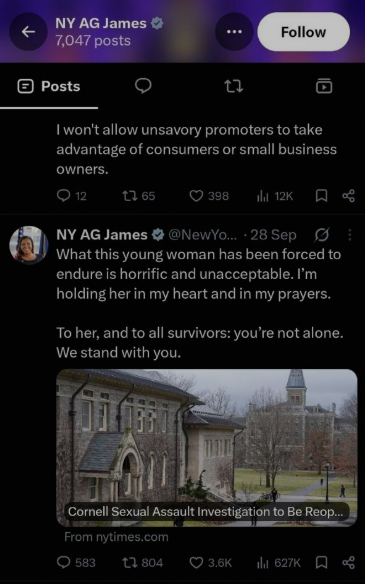
On September 28, three days before Executive Order No. 64, James posted that what the young woman had been forced to endure was “horrific and unacceptable.” Her statement also referred to survivors. Lopes argues that these words went beyond sympathy and communicated acceptance of disputed allegations before the special prosecutor had undertaken her assigned review. James and Hochul argue that the post was empathetic, not a finding of anyone's guilt. A fair reading must acknowledge both points: the post never explicitly says Lopes or another named defendant is guilty, but it was made by the official who would soon be entrusted to assess contested evidence. Petition, ¶¶ 7–9, 32–47 · Memorandum, pp. 26–34
That distinction cannot simply be waved away with the adjective “empathetic.” The narrower question is whether a reasonable observer, aware of the precise wording and the subsequent appointment, would have legitimate concerns about the appearance of prejudgment. That is a question worth examining even if the evidence ultimately falls short of the exceptionally demanding legal standard for disqualification.
Executive power is broad. It is not the whole inquiry.
Hochul relies on New York Executive Law § 63(2), under which the Governor may require the Attorney General to exercise prosecutorial powers normally held by a district attorney. In Matter of Johnson v. Pataki (1997), the Court of Appeals recognized broad superseder authority and sharply limited review of the Governor's discretionary decision. Lopes himself acknowledges that authority. His actual argument is narrower: whether this particular Attorney General should personally exercise the resulting powers after making those public remarks. Executive Law § 63 · Johnson v. Pataki
The state's memorandum leans heavily on the Governor's appointment power. Yet the existence of a lawful power and the ethics of its exercise are distinct issues. A Governor may have lawful authority to designate a prosecutor while questions still arise about the designated prosecutor's individual participation. The difficult judicial issue is whether New York law permits this objection to be adjudicated now, before indictment—not whether public confidence and professional judgment are unimportant.
The order itself directs a “full, reasoned, and independent investigation.” It authorizes James or her designee to gather and analyze evidence, interview witnesses, and review investigative and scientific reports. It also replaces the local district attorney's authority within the order's scope. That gives the state a practical question to answer: what procedures will protect the investigation against confirmation bias and ensure that contradictory evidence is evaluated with the same seriousness as evidence supporting a charge? Those questions are not proof of misconduct; they are accountability questions arising from the state's own published mandate. Executive Order No. 64
Another unanswered tension is visible in the Governor's own order. Its recitals cite concerns that the local investigation could not be conducted, or could not be perceived as conducted, without conflict or bias. Those recitals include assertions about the district attorney's earlier handling of the report; they are the Governor's stated reasons, not findings independently adjudicated in this Article 78 case. The state now says appearance-based concerns about the newly appointed prosecutor are inadequate to justify judicial interference. The situations are legally different—executive supersession and judicial disqualification have different rules—but when the purpose of the appointment is to restore confidence, the distinction deserves a forthright explanation rather than a purely procedural answer. Executive Order No. 64, p. 2 · Memorandum, pp. 31–34
The timing trap: too early to object, too late to undo?
The state contends that Lopes's concerns about interviews, evidence gathering, grand-jury presentation, and charging decisions are speculative until something more concrete happens. Its memorandum invokes Schumer v. Holtzman, a Court of Appeals case that declined to decide an early disqualification claim on an undeveloped record. This is a serious argument, and an Article 78 writ of prohibition is an extraordinary remedy—not a general-purpose mechanism to supervise investigators. Schumer v. Holtzman
But Lopes identifies a practical asymmetry: by the time charges are brought, investigators will already have chosen whom to interview, which lines of inquiry to pursue, and what evidence to present. A later challenge may address legal prejudice, yet cannot always replay every foregone investigative choice. The state's reliance on ripeness may be doctrinally well grounded while leaving this public-interest concern unresolved. That tension deserves an answer beyond simply labeling anticipated harm “speculative.” Petition, ¶¶ 56–59, 64–68 · Memorandum, pp. 12–19, 28–31
What about exculpatory evidence?
One striking passage of the state's memorandum explains that prosecutors generally need not present grand-jury evidence in the way most favorable to a potential defendant. That is a fair description of the limited function of a grand jury; it is not an exemption from professional duties. New York Rule of Professional Conduct 3.8 separately requires prosecutors in criminal litigation to disclose known information tending to negate guilt, subject to the rule's terms and protective orders. Those legal obligations are not identical: a limited duty to present certain material to a grand jury does not erase duties concerning disclosure or the obligation to decide whether a charge is supportable. Memorandum, p. 34 · New York Rule 3.8
This is why the order's language about an independent investigation should receive attention. Independence requires the capacity to reach a conclusion that contradicts a widely reported civil complaint, just as it requires the capacity to pursue credible evidence supporting that complaint. A public criminal inquiry is neither a mechanism for vindicating social-media commentary nor a substitute jury trial conducted by public opinion.
The precedents are demanding—and not one-sided
The state's best legal argument is that sympathy is not disqualifying bias. Schumer sets a high threshold for removal of an elected prosecutor, and Johnson supplies considerable protection to the Governor's superseder decision. Conversely, in People v. Adams (2013), New York's highest court recognized that exceptionally serious appearances of prosecutorial impropriety can sometimes justify disqualification even without a finding of actual wrongdoing. Adams involved concrete indications of differential prosecutorial treatment that are not established by these filings. It therefore cannot honestly be presented as controlling proof that James must be removed. It does, however, show why the appearance question is not inherently frivolous. Schumer · People v. Adams
The state's filings seek dismissal with prejudice. Lopes requests more limited relief than cancellation of the entire inquiry: modification or annulment of the designation insofar as it permits James personally to direct the matter, and potential reconsideration by the Governor. Executive Order No. 64 already contemplates action by a designee; whether delegation or a genuinely independent replacement would satisfy all concerns is a separate legal and practical question, not something the filings resolve. Petition, ¶¶ 60–63 and request for relief · Memorandum, conclusion
What the public should ask next
Was the prosecutor's September 28 statement merely an acknowledgment of a serious accusation, or did its wording convey a view about facts still to be tested? What protections ensure that material inconsistent with the civil complaint is examined? Who reviews the investigative decisions if the person directing them is the same official whose earlier statement is challenged? And, if the state insists judicial review must wait, what meaningful safeguard exists in the meantime?
None of these questions establishes that the complainant fabricated allegations or that any accused person committed a crime. The allegations remain disputed, and civil pleadings are not criminal verdicts. The October 22 papers are an opposition brief, not a court ruling. Accountability should mean investigating the allegations thoroughly, protecting the complainant from harassment, and affording every accused person the presumption of innocence—not declaring either side's account settled in advance.
-Chief Justice William Rehnquist, majority opinion, 485 U.S. at 55.