
How an Ivy League university surrendered to cancel culture, attempted to police private residences, and discovered that public pressure is no substitute for legal authority.
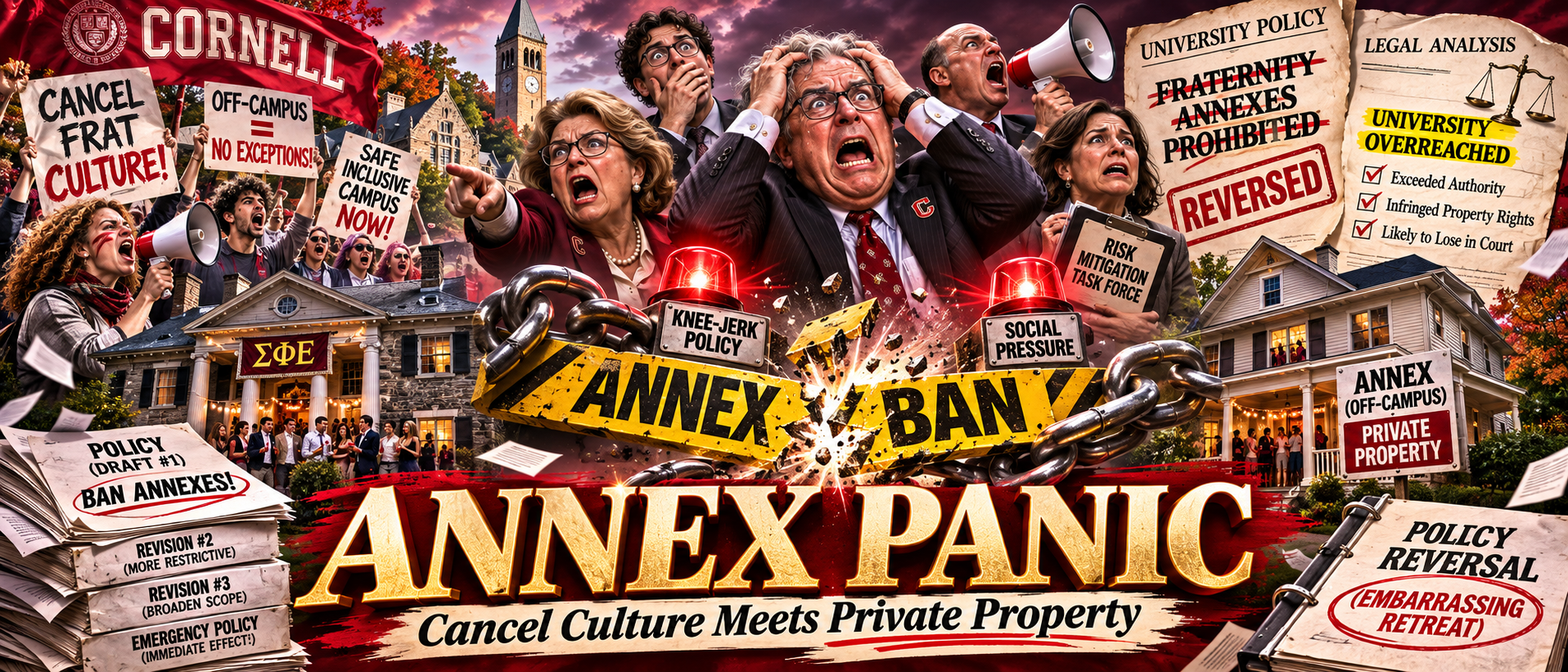
Media Metadata
FIRST CAME THE OUTRAGE. THEN CAME THE PANIC. FINALLY, SOMEONE APPARENTLY FOUND THE LAW BOOKS.
It took Cornell University approximately three weeks to demonstrate one of the great absurdities of modern American higher education: an institution capable of producing world-renowned legal scholars can apparently struggle to distinguish its own campus from somebody else's living room.
On October 13, 2026, Cornell President Michael Kotlikoff announced sweeping restrictions on fraternity social activities for the remainder of the academic year.
By October 16, university officials had reportedly expanded those restrictions to fraternity annexes, off-campus residences frequently rented by individual students rather than owned or operated by the university or the fraternity itself.
By November 2, the annex prohibition had been withdrawn.
Twenty days.
That was apparently enough time for the Ivy League's finest administrative minds to discover something familiar to millions of Americans who have never attended Cornell Law School:
Owning a university does not mean owning the entire town.
And therein lies the extraordinary story of an institution that appears to have confused reacting to social outrage with exercising sound judgment.
OCTOBER 13: CANCEL CULTURE ARRIVES AT THE PRESIDENT'S OFFICE
The controversy began with serious allegations involving a reported 2024 sexual assault at Cornell's Chi Phi fraternity.
A former student, publicly identified in litigation under the pseudonym Jane Doe and identified by us by her real name Lucile H. Craig (Lucy Craig), filed a civil lawsuit in September 2026 alleging sexual violence involving fraternity members.
The allegations warrant serious consideration, appropriate investigation, and fair adjudication.
But allegations against particular people are not findings of misconduct against every fraternity member at an entire university.
That distinction, apparently, became inconvenient.
Following protests, widespread criticism, and mounting demands for institutional action, President Kotlikoff announced a suspension of all parties and social events inside IFC fraternity houses through May 31, 2027.
His October 13 presidential statement explicitly connected the decision to conversations with the university community and campus protests.
More remarkably, he acknowledged that an independent investigation led by former Deputy U.S. Attorney General Sally Yates was underway, but that Cornell would act before receiving its findings.
Think about that.
Cornell had commissioned an independent examination of its policies and practices, presumably because informed conclusions matter.
Then the administration decided it could not wait for informed conclusions.
Why wait for evidence when you can announce a punishment and call it progress?
This is the institutional logic of cancel culture: a controversy generates outrage, outrage creates reputational pressure, and administrators scramble to demonstrate that they are doing something.
Whether that something is proportionate, justified, or even effective becomes a secondary consideration.
The president's original directive applied specifically to social events inside IFC fraternity houses. Importantly, it did not impose an identical ban on Panhellenic sororities or Multicultural Greek and Fraternal Council organizations.
Nevertheless, the consequences extended across the IFC fraternity community, including chapters and students who had not been found responsible for the alleged 2024 misconduct.
What exactly did an unrelated fraternity do to deserve losing its social privileges for the academic year?
Apparently, it belonged to the wrong category of student organization at the wrong political moment.
OCTOBER 16: THE ADMINISTRATION DISCOVERS THE ANNEX
Three days later, the situation became even more absurd.
Cornell's Sorority and Fraternity Life representatives reportedly communicated that the prohibition would extend to off-campus fraternity annexes.
For the unfamiliar, an annex is commonly a privately rented residence where fraternity members live together. It may be associated socially with a fraternity without being owned by the organization or the university.
These are important distinctions.
The original presidential directive addressed IFC fraternity houses.
The subsequent interpretation appeared to reach beyond those houses into students' private living arrangements.
At this point, the university's administrative ambition apparently exceeded its understanding of the boundaries it was attempting to regulate.
One can almost imagine the emergency meeting.
"President, the fraternity members are gathering somewhere else."
"Where?"
"At their homes."
"Well, ban those too."
Brilliant.
Somebody notify the Nobel committee.
The actual legal distinction, of course, is more complicated. Cornell has authority to regulate recognized student organizations and impose conditions on official chapter-sponsored activities, including some held off campus.
But that authority does not magically transform every privately leased residence into university property.
An institutional conduct policy is not a property deed.
And an administrator's desire to control an event does not establish an unlimited legal right to prohibit private gatherings.
NOVEMBER 2: CORNELL DISCOVERS THE DIFFERENCE
After approximately two and a half weeks of reported restrictions on annex events, Cornell reversed course.
Its current Interfraternity Council Social Event Suspension Quick Guide contains the particularly revealing acknowledgment:
"While the University does not control events in personal residences"
There it is.
One of America's most prestigious universities has publicly acknowledged that students possess private residences beyond the direct control of their university.
A stunning intellectual breakthrough.
Perhaps next semester Cornell can introduce an introductory course entitled Property Rights 101: Why Your Dean Is Not Your Landlord.
The clarification is especially striking because Cornell's October 19 official FAQ had already described the suspension as applying to social events at IFC chapter houses.
Yet the annex restriction had reportedly been communicated separately, creating confusion between the president's written directive, the university's formal public explanation, and instructions delivered to Greek Life leaders.
Which policy were students supposed to follow?
The president's written order?
The university's published FAQ?
Or whatever a representative communicated at the latest meeting?
For an institution that routinely expects students to navigate complex codes of conduct, this is an embarrassing demonstration of administrative inconsistency.
DOES CORNELL HAVE A LAW SCHOOL, OR JUST A VERY EXPENSIVE BUILDING FULL OF LAW BOOKS?
Here is where the situation becomes legally interesting.
Cornell's own Universal Recognition Policy for Student Organizations recognizes that fraternities and sororities are independent legal entities.
It also reserves the university's authority to condition recognition on compliance with institutional policies, regulate certain organizational conduct, and address misconduct even when it occurs away from campus.
Those powers are real.
But they are not unlimited.
A privately leased home is not necessarily a recognized fraternity facility. A private gathering of students is not automatically an official chapter-sponsored event. And merely having multiple fraternity members living together does not, by itself, establish that every gathering is an organizational function.
This distinction creates substantial questions about whether the reported annex prohibition was sufficiently grounded in the university's published rules.
New York law also imposes limitations on how private educational institutions exercise disciplinary authority.
In Tedeschi v. Wagner College, 49 N.Y.2d 652 (1980), the New York Court of Appeals established that private colleges must substantially observe their adopted disciplinary procedures.
That decision does not automatically invalidate Cornell's annex restriction. Nor does private ownership categorically exempt students or recognized organizations from university conduct rules.
But it illustrates the broader principle that a university's disciplinary authority must be exercised within its actual legal and procedural boundaries.
If Cornell attempted to impose additional restrictions beyond its original directive, the legitimate questions include:
What written policy authorized the additional prohibition?
How did Cornell distinguish personal residences from fraternity-controlled organizational property?
Were affected chapters given clear notice of what was prohibited?
Did the university consider the individual circumstances of each organization?
Was the restriction proportional to the risks it purported to address?
Those are not unreasonable questions.
They are precisely the questions that competent university lawyers should anticipate before administrators start issuing sweeping prohibitions.
And yes, Cornell has a law school.
A very famous one.
Perhaps someone should have called it.
COLLECTIVE PUNISHMENT IS NOT A SUBSTITUTE FOR JUSTICE
At the heart of this controversy lies a troubling question.
When allegations concern particular individuals and particular events, why should an entire community lose its privileges?
No reasonable person should dismiss the importance of protecting students from sexual violence.
Nor should anyone suggest universities must wait for criminal convictions before adopting reasonable safety precautions.
But legitimate prevention and indiscriminate restrictions are not the same thing.
The university could strengthen event monitoring, establish meaningful accountability, improve reporting procedures, and investigate specific organizations where evidence justifies additional scrutiny.
Indeed, Cornell's revised policies now contain enhanced measures covering event registration, sober monitors, transportation arrangements, and other safety requirements.
Those are concrete rules addressing identifiable risks.
What is considerably harder to justify is the proposition that every IFC fraternity should bear restrictions as a symbolic response to allegations involving others.
This is where contemporary cancel culture becomes particularly dangerous.
The demand is no longer simply that wrongdoing be investigated and those responsible held accountable.
The demand becomes that somebody, preferably somebody visible, must be punished immediately to demonstrate institutional solidarity with a prevailing social narrative.
Due process is inconvenient.
Individual responsibility is complicated.
A sweeping announcement is easy.
And so the announcement gets made.
WHY FREE SPEECH PLATFORMS MATTER
There is another lesson in Cornell's retreat, and it extends far beyond Greek Life.
Independent publishers such as LucyCraig.blog exist precisely because public debate cannot be entrusted exclusively to institutions that are themselves under pressure to conform.
When universities, corporate interests, activists, and prominent commentators are pushing a preferred narrative, it becomes tempting for everyone else to remain silent.
Question the university's response and risk being accused of opposing survivors and labelled a "bigot" by a two bit famefag unethical retarded lolwyer like Thomas Giuffra.
Question the scope of restrictions and risk being accused of defending misconduct.
Question collective punishment and risk becoming the next target of a cancellation campaign.
That is how meaningful debate gets replaced by compulsory agreement.
LucyCraig.blog has refused to accept the proposition that questioning a public narrative is inherently improper.
It has insisted that allegations, institutional conduct, legal documents, policy decisions, and official statements remain subjects for public scrutiny.
That scrutiny matters even when the questions are uncomfortable.
We cannot establish that independent commentary caused Cornell to reverse its annex policy, and it would be irresponsible to claim a specific causal role without evidence.
But the broader question is unavoidable.
Without independent voices willing to challenge the dominant narrative, how much longer might an overbroad and poorly explained restriction have remained in place?
Would administrators have revisited the distinction between university-controlled facilities and private residences?
Would the contradiction between the written presidential directive and subsequent guidance have received meaningful scrutiny?
Or would the restrictions simply have become another permanent feature of institutional life, accepted because nobody wanted the reputational consequences of objecting?
Free speech is not valuable merely when it reinforces fashionable opinions.
It is most valuable when those with power would prefer that uncomfortable questions remain unanswered.
And it is particularly important when public outrage threatens to overwhelm the distinction between justice and retaliation.
THE UNIVERSITY BACKED DOWN. THE BIGGER PROBLEM REMAINS.
Cornell's annex reversal deserves acknowledgment.
Correcting an overreaching policy is preferable to defending it indefinitely.
But the reversal does not erase the original judgment problem.
Nor does it end the suspension of social events inside IFC fraternity houses, which remains scheduled to continue through May 31, 2027.
The administration has narrowed its approach, but the fundamental question of proportionality remains unresolved.
The university should explain precisely why the annex restriction was communicated, what legal and institutional authority supported it, and what caused the subsequent change.
Was this a legal reassessment?
An acknowledgment of an overbroad interpretation?
An attempt to correct conflicting instructions?
Or simply the realization that the original expansion was unenforceable in the manner administrators had envisioned?
Those answers matter.
Because a university that issues broad restrictions under pressure and quietly retreats afterward risks teaching its students a particularly unfortunate lesson:
The rules are whatever the administration says they are, until someone important notices a problem.
FINAL THOUGHT: AN IVY LEAGUE DEGREE CANNOT REPLACE A SPINE
Cornell University's administrators faced legitimate public concern over serious allegations of sexual misconduct.
They had a responsibility to respond.
They also had a responsibility to think.
Instead, their handling of fraternity social restrictions presents an unfortunate illustration of how an institution can allow an atmosphere of intense public pressure to produce sweeping decisions, confusing instructions, and ultimately an embarrassing retreat.
The campus-safety challenges remain.
The allegations still warrant fair consideration.
The rights of complainants and accused students still matter.
And Cornell still has an obligation to demonstrate that its decisions are guided by evidence, proportionality, established authority, and coherent procedures.
But the annex episode deserves to be remembered for what it suggests about university governance under pressure.
First they banned the parties.
Then they reportedly banned the parties at private residences.
Then they acknowledged that private residences were not theirs to control directly.
Somewhere inside Cornell's administration, an extraordinary discovery was made:
Cancel culture does not convey title to real estate.
Congratulations, Cornell.
You have rediscovered the boundary between the university and the rest of the world.
Now perhaps you can rediscover the difference between justice and collective punishment.
New York Times Co. v. Sullivan, 376 U.S. 254, 270 (1964). Majority opinion.