
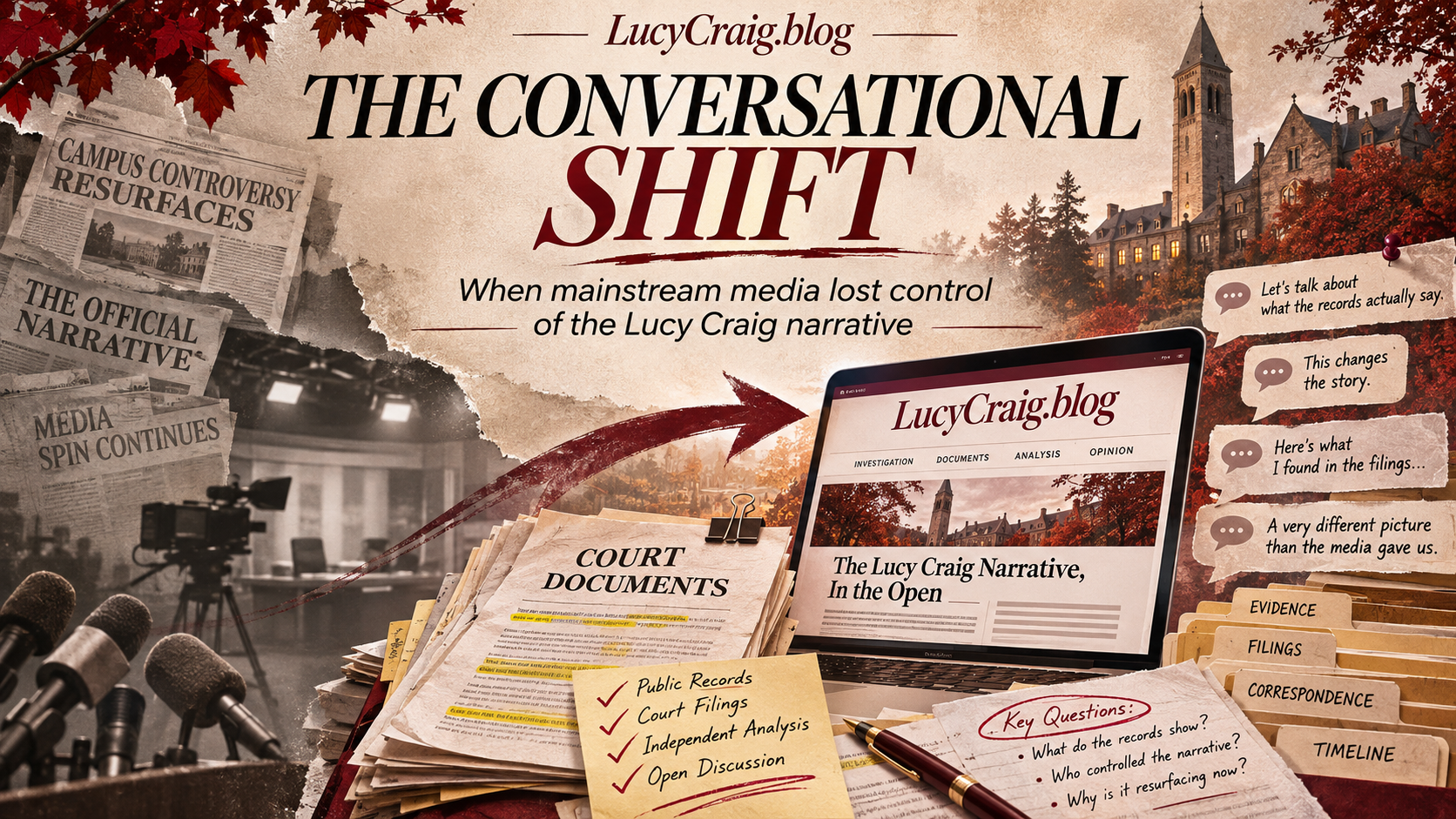
Did the press simply lose interest in the Cornell Seven controversy, or did LucyCraig.blog fundamentally change who controlled the conversation?
Media Metadata
FIRST CAME THE HEADLINES. THEN CAME THE QUESTIONS. THEN CAME THE DOCUMENTS.
For a brief, extraordinary period, the mainstream media appeared almost obsessed with the Cornell Seven controversy.
The allegations were explosive. The university was prestigious. The defendants were young men associated with an Ivy League fraternity. The plaintiff, Lucile H. Craig, publicly known in the litigation as Jane Doe, occupied the center of a national controversy involving sexual assault allegations, university discipline, criminal investigations, and institutional accountability.
It was practically irresistible television.
The formula was familiar: sensational allegations, emotional interviews, anonymous sources, dramatic headlines, and a procession of commentators prepared to discuss the supposed failures of Cornell University.
The public was invited to be outraged.
What it was not always invited to do was independently examine the entire evidentiary record.
And then something rather inconvenient happened.
LucyCraig.blog entered the conversation.
Suddenly, a growing audience had somewhere else to go. Somewhere that did not require accepting a reporter's preferred interpretation of a legal document. Somewhere that welcomed uncomfortable questions, published competing arguments, preserved source materials, and allowed readers to argue with one another.
The public conversation began to change.
And while mainstream coverage has not literally stopped, its initial fever pitch has noticeably given way to a more complicated, less easily packaged story.
Coincidence?
Perhaps.
But we suspect something more interesting happened.
THE ORIGINAL PRODUCT WASN'T JUST NEWS. IT WAS A NARRATIVE.
Consider how the controversy initially reached millions of Americans.
A civil complaint containing extraordinary allegations against seven young men arrived in the public arena. News organizations understandably recognized an enormous story.
But too frequently, the resulting coverage seemed to blur a distinction that should be sacred to journalism:
An allegation is not a finding. A complaint is not a conviction. And a headline is not evidence.
Readers encountered carefully selected quotations, summaries of disputed documents, emotional accounts, and commentary about institutional failure.
Some outlets did valuable original reporting and examined competing evidence. That deserves recognition.
Others appeared more interested in the emotional architecture of the story than its procedural complexity.
The public was often given the conclusion before being encouraged to inspect the material from which that conclusion had supposedly been drawn.
Meanwhile, the identities of the accused men circulated extensively, while the plaintiff received anonymity protections.
There are legitimate reasons to protect the identity of someone reporting sexual assault. There are equally legitimate reasons to question whether the accused deserve comparable protection from reputational destruction before liability has been established.
Indeed, the judge subsequently permitted the plaintiff to continue anonymously while suggesting that similar privacy protections could be extended to the defendants.
That is a rather important development in a case where public identification itself has become a powerful consequence.
The question is not whether accusers deserve protection.
The question is whether fairness should be reserved for only one side of a courtroom.
THEN SOMEONE HANDED THE PUBLIC THE LIBRARY CARD.
Traditional media organizations have spent decades operating on an implicit understanding: journalists collect the information, editors decide what is important, and the audience receives the finished product.
Sometimes that system works brilliantly.
Sometimes the editorial filter becomes the story.
LucyCraig.blog challenged that arrangement by developing something more useful than another opinion column.
It developed an accessible, searchable public archive.
Court filings. Police records and statements where lawfully available. Legal pleadings. Supporting exhibits. Videos. Transcripts. University materials. Public communications. Articles explaining the relationships between documents.
And yes, even memes.
Because apparently a subject can be both legally consequential and occasionally deserving of ridicule.
Rather than merely telling readers what a document supposedly established, the site made primary materials accessible so readers could examine the language themselves.
Want to compare statements made at different stages of an investigation?
Consult the documents.
Want to understand why one legal pleading contradicts another?
Read both, examine their dates, and consider the different legal standards involved.
Want to evaluate an attorney's public description of an event?
Compare it with the available record.
Want to disagree with our interpretation?
Excellent.
Bring the evidence.
That last proposition may be the most disruptive part of the entire operation.
An informed reader is no longer entirely dependent upon the person holding the microphone.
THE COMMENT SECTION THE ESTABLISHMENT DIDN'T CONTROL.
Perhaps the most fascinating development was not the document library at all.
It was the conversation underneath it.
Mainstream publishers have increasingly restricted, eliminated, or monetized opportunities for meaningful reader participation. Some require subscriptions. Others outsource discussion to social media platforms where algorithms and moderation rules influence visibility.
LucyCraig.blog took a different approach.
Open public comments. Free participation. Replies to replies. Arguments, counterarguments, criticism, sarcasm, and disagreement.
No subscription required to participate.
You could criticize Lucile Craig.
You could defend her.
You could criticize the seven defendants.
You could defend them.
You could challenge Cornell, the lawyers, the investigators, the news media, or the editorial positions of this very website.
And plenty of people did.
The site's published-comment analysis documented 3,286 public comments across 174 page locations between October 6 and October 30, 2026. Of those, 2,274 were replies, evidence of sustained exchanges rather than merely isolated reactions.
These are the site's own archival figures, not an independent audit of audience opinion. Nor does comment volume prove which side of the underlying dispute is correct.
But the phenomenon matters.
A conventional news story can generate fleeting outrage.
A genuinely interactive discussion can generate days of scrutiny, renewed investigation, and competing interpretations.
People began debating not simply what happened at Cornell, but what the evidence meant, what the law required, how the media framed the controversy, and whether public reactions were proportionate to what had actually been established.
The audience stopped behaving like an audience. It started behaving like participants.
And perhaps that was never supposed to happen.
THE UNCOMFORTABLE TRUTHS DID NOT RESPECT ANYONE'S PREFERRED STORY.
An independent editorial platform has one significant advantage over a publication committed to maintaining a particular storyline.
It can disappoint everybody.
On LucyCraig.blog, criticism has not been confined to one party.
Lucile H. Craig's public allegations and the available accounts have been examined. So have the statements and conduct attributed to the seven men.
Cornell University's administrative decisions have been challenged.
The decisions of investigators, university officials, attorneys, and public authorities have been subjected to examination.
Procedural questions that are not particularly fashionable on television have become subjects of extensive discussion.
What does intoxication mean under applicable consent standards?
What can actually be inferred from discrepancies between statements?
Why do timelines matter?
What is the difference between a university disciplinary finding and a criminal conviction?
What happens when a civil lawsuit presents allegations that differ from earlier accounts?
And how should the public treat accusations that remain contested?
These questions are not attacks on sexual assault survivors.
They are questions that arise whenever serious allegations carry potentially devastating consequences.
Due process is not a loophole. Skepticism is not a crime. And evidence does not become irrelevant simply because it makes an emotionally satisfying narrative less comfortable.
Equally, documentary discrepancies do not automatically establish dishonesty, and the absence of criminal charges does not establish that an assault never occurred.
The available evidence must be assessed on its merits.
That's precisely why access to the record matters.
THE MILLION-VIEW PROBLEM.
There is another element that deserves attention.
Traffic.
LucyCraig.blog coverage has attracted millions of page views, despite operating without the marketing infrastructure, established distribution networks, and corporate resources of major news organizations.
Its operators also describe difficulties involving platform visibility, search indexing, and attempts to restrict the site's reach.
Comparing the blog's reported page views against the combined readership of mainstream stories would require comparable, independently verified analytics.
But the broader point does not require a comparison.
An independently operated website devoted to a single controversy has attracted a substantial audience by providing something that many readers were searching for:
The opportunity to examine more than one version of the story.
Readers were not necessarily looking for another institution to tell them whom to believe.
They wanted to understand why they should believe anything at all.
That is a fundamentally different product.
It is also a rather uncomfortable development for anyone accustomed to controlling public perception through carefully timed announcements, selective excerpts, or exclusive interviews like Lucy Craig's lolwyer who almost immediately sent LucyCraig.blog a frivolous DMCA take down notice.
WHY DID THE MEGAPHONES GROW QUIETER?
Now we arrive at the central question.
Why does the controversy seem to have lost some of its original mainstream intensity?
The initial sensational allegations no longer exist in isolation.
There are now competing legal arguments, substantial investigative materials, disputes about documentary interpretation, questions about institutional conduct, and judicial rulings complicating the early public narrative.
The story is no longer reducible to one allegation and one emotional response.
There are several possible explanations for the change in attention.
Perhaps the news cycle simply moved on.
Perhaps major publications are waiting for consequential developments from prosecutors or the courts.
Perhaps journalists are exercising greater caution as more information becomes available.
Or perhaps, just perhaps, the growth of independent scrutiny has made the original framing harder to sustain without substantial qualification.
We can observe that the public no longer needs mainstream and legacy media editors and producers to continue examining the case for them. They are adults who can find, analysis and come to their own conclusions here at LucyCraig.blog.
THE MEDIA COULD CONTROL A HEADLINE. IT COULDN'T CONTROL THE QUESTIONS.
The great vulnerability of narrative-driven journalism is that it depends upon the audience accepting the authority of the storyteller.
Once audiences can access source documents, compare competing claims, and publicly challenge interpretations, the traditional relationship changes.
News organizations still have resources, professional expertise, access to witnesses, and reporting capabilities that independent publishers may lack.
Those advantages matter.
But institutional size is not a substitute for accuracy.
Nor does independent publishing automatically guarantee it.
LucyCraig.blog must be held to the same standard it demands of everyone else: factual assertions should be supported, allegations distinguished from findings, corrections made when necessary, and genuinely private or legally protected information handled responsibly.
That is the price of credibility.
And it is a price worth paying.
Because the objective should never be to replace one untouchable narrative with another.
The objective should be to make untouchable narratives impossible.
THIS WAS NEVER SUPPOSED TO BE A ONE-WAY CONVERSATION.
Perhaps the most remarkable achievement of LucyCraig.blog is not whether it changed the minds of people who initially believed Lucile Craig, doubted her, defended Cornell, or condemned the seven men.
Perhaps it is that thousands of people found a place to argue about all of those positions without first asking a national newspaper for permission.
The public could read.
The public could research.
The public could question.
And the public could disagree.
The documents didn't need to be delivered through thirty seconds of television narration.
The legal issues didn't need to be reduced to a sensational headline.
And the comments didn't need to disappear behind a subscription screen.
As the public record expands, the contradictions, agreements, uncomfortable details, and unresolved questions become available for examination by people with no institutional interest in protecting any particular outcome.
That is not a guarantee of truth.
But it offers a better opportunity to test claims than unquestioning acceptance of an editorial interpretation.
THE CONVERSATION HASN'T ENDED. IT HAS CHANGED HANDS.
Maybe the mainstream media will return with another wave of headlines.
Maybe the reopened investigation will produce significant developments. Maybe the civil proceedings will expose new evidence. Maybe Cornell's independent review will provide meaningful answers.
Or maybe the eventual findings will disappoint almost everyone who has already decided what happened.
Whatever comes next, something important has already changed.
The media no longer enjoys an exclusive position between the public and the controversy.
The library remains accessible.
The documents remain available where publication is lawful.
The questions remain open.
The comment section continues.
And the public continues examining the record, whether or not a television producer believes the story deserves another segment.
Mainstream media helped make the Cornell Seven controversy national news.
LucyCraig.blog helped turn it into an ongoing public examination of the evidence, the institutions, the legal arguments, and the media itself.
Perhaps that explains part of the change in attention.
Perhaps it doesn't.
But this much is clear:
A newspaper can stop publishing tomorrow.
A television network can move to the next controversy.
A commentator can abandon yesterday's certainty and discover a new outrage.
The documents will still be there.
And so will the questions.
ONE FINAL THOUGHT
The greatest threat to a carefully curated narrative is not necessarily another narrative.
It is a public that insists on reading the source material.
The courtroom, not the comment section, will ultimately determine legal liability.
Until then, everyone is entitled to ask questions.
Including the uncomfortable ones.
New York Times Co. v. Sullivan, 376 U.S. 254, 270 (1964). Majority opinion.
New York Times Co. v. Sullivan, 376 U.S. 254, 270 (1964). Majority opinion.