
The evolving allegations in Lucile H. Craig's case raise fundamental questions about sworn statements, witness credibility, university investigations, and the consequences when public opinion moves faster than the evidence.
When the facts become a moving target
Media Metadata
On October 19–20, 2024, an encounter involving a Cornell University student and members of the Chi Phi fraternity became the subject of allegations that would ultimately generate national headlines, disciplinary proceedings, civil litigation, and a reopened criminal investigation.
WIJDR identifies the woman proceeding under the court-approved pseudonym Jane Doe as Lucile H. Craig, also known as Lucy Craig. The public court docket continues to identify the plaintiff as Jane Doe.
The central issue examined here is not whether Craig deserves to be heard. Every person reporting sexual assault deserves a serious investigation.
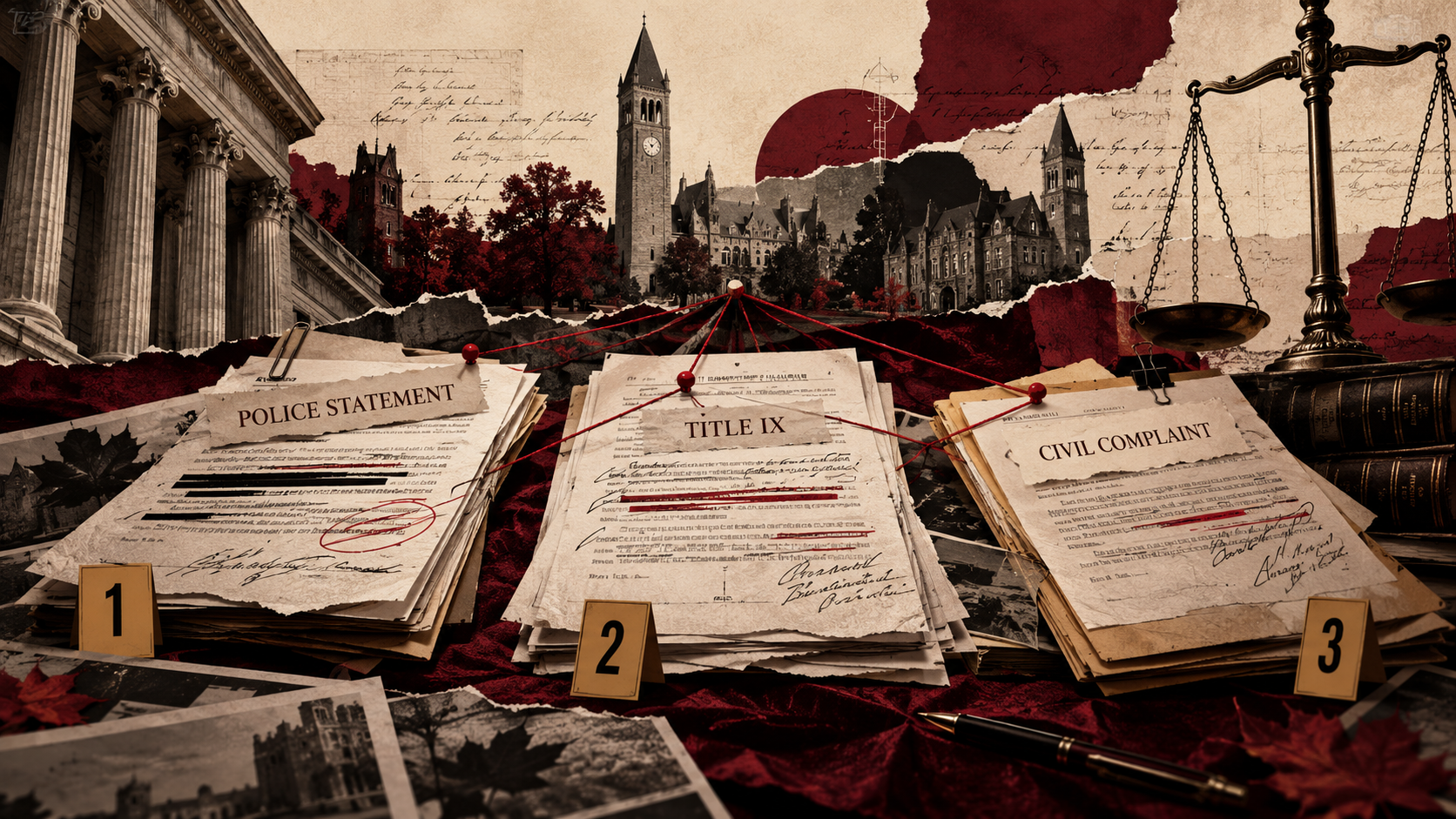
The issue is what happens when a complainant's descriptions of material events differ across a police investigation, university disciplinary proceedings, and a subsequent civil complaint.
And, perhaps more importantly, what happens when the public treats those allegations as established facts before the evidence has been tested?
The Cornell controversy has already produced reputational damage, political intervention, institutional investigations, and university policy changes.
But its most consequential legacy may belong to the people who have never heard of Lucy Craig.
The next person reporting an actual sexual assault may face the skepticism generated by this controversy. The next innocent person accused of sexual misconduct may face the opposite problem: a system unwilling to challenge an allegation once the public has embraced it.
Both consequences deserve examination.
I. The original police investigation: What did Craig actually sign?
The alleged events occurred October 19–20, 2024.
Craig reported the matter to Cornell University Police on November 8, 2024. A detailed police interview took place on November 14–15, more than three weeks after the incident.
According to CBS News, investigators prepared a six-page written statement based on those interviews. Craig reportedly reviewed the statement and made more than twenty handwritten corrections before signing it.
The complete interview transcript has not been located in an official public release, although CBS obtained a copy from a source and published excerpts.
The distinction between these documents is crucial.
On September 28, 2026, Tompkins County District Attorney Matthew Van Houten publicly defended his office's original decision not to pursue criminal charges.
Van Houten stated that Craig's signed statement described voluntary drug use and consensual sexual activity, rather than the forced drugging and gang rape alleged in the later civil complaint.
One particularly notable passage concerned ketamine.
According to the district attorney's reproduction of the signed statement, a male participant placed ketamine on his erect penis, implying that Craig should inhale it. She described deciding to use the drug and subsequently inhaling it.
The civil complaint, by contrast, portrays the evening as involving coercion, drug-induced incapacitation, and sexual acts to which Craig did not consent.
Those differences deserve careful examination.
There is a meaningful distinction between voluntarily choosing to ingest a drug, ingesting it under pressure, and having it administered against one's will.
There is also an important distinction between voluntarily ingesting a substance and remaining legally capable of consenting to sexual activity afterward.
One cannot simply collapse all these circumstances into a single finding of consent or coercion.
The proper question is whether the same specific events were described differently, and, if so, what evidence explains those differences.
II. The unreleased interview complicates the narrative
The district attorney's description of the signed statement is not the entire investigative record.
In September 2026, CBS News reported obtaining a transcript of Craig's November 14–15 police interview. However, they did not release the full transcript and LucyCraig.blog cannot make any independent evaluation of it based on reporting from a nationally disgraceful publication's interpretation alone. We demand they release the transcript in full for public evaluation. Until then, we have to treat it as non-existent or with little weight.
According to that reporting, Craig expressly alleged rape during the interview and distinguished consensual initial activity from later encounters that she described as coercive.
CBS also reported that the investigating officer prepared the written statement during that interview process.
Van Houten said he had not received the full interview transcript when his office made its original charging decision.
This introduces a separate institutional question.
If the signed statement was prepared from an interview containing explicit allegations of rape, why did the written document fail to convey those allegations in a manner that led prosecutors to pursue them?
Was the written statement incomplete?
Did the interview contain allegations that could not be supported by the descriptions of specific acts?
Did police investigators fail to convey relevant evidence?
Or did prosecutors interpret the information too narrowly?
These questions cannot be answered conclusively without examining the full original records.
But one principle should be uncontroversial.
Neither prosecutors nor the public should selectively rely on whichever version of an account best supports a preferred conclusion.
A signed statement matters. So does the interview from which it was prepared.
A detailed investigation should examine both.
III. The university investigation: Another evidentiary record
III. The university investigation: Another evidentiary record
In 2025, Cornell conducted disciplinary proceedings concerning the allegations.
The investigation involved multiple witnesses, substantial documentary evidence, and a lengthy hearing.
Cornell ultimately imposed sanctions against several students. The university's findings were not identical for every respondent.
That distinction is essential.
A university's disciplinary responsibility finding is not a criminal conviction, and allegations concerning one individual cannot automatically establish wrongdoing by another.
The disciplinary process also produced records describing what Craig said about the evening, including her understanding of initial consent, later coercion, intoxication, and memory gaps.
The existence of those additional records raises questions about the development of her account.
Which factual descriptions remained consistent?
Which details were added?
Which statements were clarified?
And which, if any, directly contradicted earlier representations?
An omission is not necessarily a contradiction.
A later description of an event may provide additional context without reversing what was said previously.
But when an earlier and a later account make incompatible factual claims about the same act, those differences are legitimate subjects for inquiry.
It is important not to declare that the entire Title IX account contradicts the signed police statement without a complete, passage-by-passage comparison of the underlying records.
The portions publicly reported to date demonstrate why such a comparison is necessary.
IV. The civil lawsuit: A substantially different presentation
On September 16, 2026, Craig filed a civil lawsuit in New York County Supreme Court against Cornell University, fraternity members, and other defendants.
The complaint described extensive alleged sexual violence, coercion, and drug-induced incapacitation.
Van Houten publicly characterized the civil allegations as materially different from the facts contained in the original signed police statement.
This was not merely a disagreement about terminology.
Questions concerning whether drugs were voluntarily consumed, whether a particular sexual act was resisted, whether a person was conscious or incapacitated, and which individuals participated can determine the legal consequences of an encounter.
The civil complaint's allegations have not been established merely because they appear in a court filing.
Likewise, the earlier district attorney's decision not to prosecute was not a judicial finding that the alleged assaults did not occur.
These are different legal processes, with different evidentiary requirements.
A civil complaint states allegations. A university disciplinary decision determines responsibility under applicable institutional rules. Criminal prosecution requires the government to establish the elements of charged offenses beyond a reasonable doubt.
Conflating those processes invites injustice.
V. Existing Supreme Court precedent: Credibility can be challenged
The Cornell litigation has not yet established a binding legal precedent concerning the alleged inconsistencies.
Nevertheless, existing law provides important guidance.
Olden v. Kentucky, 488 U.S. 227 (1988)
This United States Supreme Court case involved a sexual-assault prosecution in which the complainant's accounts varied concerning the number of alleged assailants and other details.
The defense also sought to introduce evidence concerning a possible motive to fabricate the allegation.
The Supreme Court held that restrictions on relevant cross-examination violated the defendant's Sixth Amendment confrontation rights.
The significance of Olden is not that a changing account establishes fabrication.
Rather, the case recognizes that evidence bearing materially on credibility and possible bias may be essential to a fair criminal trial.
If a witness describes an event differently on different occasions, defense counsel may have legitimate grounds to examine those differences, subject to applicable evidentiary rules.
New York CPLR § 4514
New York civil law expressly permits impeachment using certain prior inconsistent statements, including qualifying statements signed by a witness or made under oath.
The six-page statement described by Van Houten may therefore become important evidence if Craig later testifies in a manner materially inconsistent with it.
The same is true of other properly authenticated statements, subject to the applicable rules of evidence.
A prior inconsistency does not automatically invalidate a civil action.
But neither can it be treated as legally irrelevant simply because the litigation involves sexual assault.
Brady, Giglio, and criminal discovery
If a criminal prosecution follows, prosecutors must comply with constitutional disclosure duties and New York's discovery requirements.
Evidence materially undermining a prosecution witness's credibility or supporting a defense may be subject to disclosure.
New York Criminal Procedure Law § 245.20 imposes broad discovery obligations.
A complete collection of police interviews, signed statements, relevant university testimony, and other discoverable evidence could therefore become important in evaluating any criminal charges.
That is not an unusual accommodation for defendants in sexual-assault cases.
It is part of the ordinary constitutional framework protecting the integrity of criminal trials.
VI. The damage that future reporters may inherit
A case of this visibility does more than influence one courtroom.
It can influence expectations about everyone who reports sexual violence afterward.
Imagine a future complainant who initially describes an encounter as voluntary but later explains that an additional sexual act occurred without consent.
A skeptical investigator might characterize the later disclosure as an effort to change the narrative.
That could be a serious error.
Someone may consent to one act and refuse another. Intoxication, embarrassment, fear, or fragmented memory may affect what is disclosed and when.
A rigid insistence that the earliest statement must always control could discourage legitimate victims from providing corrections or additional information.
Now consider the opposite.
Suppose a complainant initially makes a specific factual statement under oath and later presents a directly incompatible account of the same act.
If institutions refuse to examine the contradiction because questioning it might appear insensitive, the investigative process becomes equally compromised.
A person's trauma may be relevant to understanding an inconsistency.
It does not independently establish which account is accurate.
The law cannot operate on the assumption that every changing account is fraudulent.
But neither can it adopt a rule that sexual-assault allegations are exempt from ordinary credibility examination.
Future victims are not protected by a system that abandons careful fact-finding. They are protected by investigators who can distinguish real evidentiary conflicts from understandable differences in disclosure.
VII. What happens when the public decides first?
The Cornell controversy has involved significant public attention and political intervention.
New York Governor Kathy Hochul appointed Attorney General Letitia James as special prosecutor following widespread scrutiny of the original investigation.
The appointment itself became the subject of legal challenges by individuals associated with the underlying allegations.
One of those challenges was advanced on behalf of Winston Lee, represented by attorney Teny R. Geragos and her colleagues.
The defense argued that public comments by government officials raised questions about impartiality and the presumption of innocence.
Those assertions remain legal arguments rather than established judicial findings.
But they illustrate a broader danger.
What happens when a prosecutor publicly expresses solidarity with a complainant before completing an independent investigation?
Support for people reporting sexual assault is not inherently improper.
Prosecutors, however, have distinct responsibilities.
They must evaluate evidence objectively and avoid treating an accusation as proof of criminal guilt.
Likewise, the public should be able to discuss troubling allegations without engaging in harassment, threats, or declaring legal conclusions that no court has reached.
There is a difference between taking allegations seriously and deciding that they are necessarily true.
VIII. The consequences of inaccurate identification
VIII. The consequences of inaccurate identification
The Cornell litigation has already generated concerns about incorrectly identified individuals.
In October 2026, a former fraternity president was dismissed from the civil action after it emerged that he had been incorrectly identified as occupying the relevant leadership role at the time of the incident.
Other reporting described the consequences of an erroneous address associated with a defendant, including threats directed toward an unrelated family.
Such mistakes demonstrate why factual precision matters.
The mere appearance of a person's name in a lawsuit can create reputational consequences extending far beyond the legal proceeding.
A later correction may receive only a fraction of the attention generated by the original allegation.
The consequences can be especially serious when an allegation involves sexual misconduct.
Yet the same concern applies to complainants.
Premature declarations that an allegation is fabricated may inflict substantial harm on someone who has experienced a genuine assault.
There is no acceptable reason to abandon accuracy for either side.
IX. The institutional precedent is developing already
On October 29, 2026, Cornell announced an agreement under which New York State Police would provide an independent investigative pathway for future sexual-assault complaints, while preserving complainants' ability to choose another participating agency.
The university has also commissioned an independent review led by former Deputy Attorney General Sally Yates.
These changes demonstrate that the controversy is already influencing institutional practices.
Whether those changes ultimately improve investigative fairness will depend on their implementation.
Independent investigation can reduce conflicts of interest.
But changing the agency responsible for an investigation will accomplish little if records remain incomplete, evidence is selectively transmitted, or investigators are discouraged from testing disputed assertions.
A reliable process should preserve original interviews, identify the date and circumstances of each statement, document all corrections, and distinguish firsthand recollection from later reconstruction.
Those safeguards protect both complainants and respondents.
X. The precedent we should fear most
The greatest danger of the Cornell controversy is not that an individual account may contain inconsistencies.
Human recollection is imperfect.
The greatest danger is that institutions may respond to those inconsistencies according to public pressure rather than evidence.
One institution may become reluctant to challenge a complainant.
Another may overcorrect and become excessively skeptical of future reports.
Both responses would be failures.
When the next victim reports an assault, investigators should not begin by assuming dishonesty because another high-profile case involved disputed statements.
When the next defendant denies an allegation, investigators should not assume guilt simply because public opinion demands accountability.
Nor should the existence of a civil lawsuit, a university sanction, or a political statement replace an individualized examination of the facts.
The law must distinguish between a genuinely evolving memory, an incomplete police summary, a material contradiction, and a deliberately false statement.
They are not interchangeable.
Only evidence can establish which explanation fits a particular case.
Conclusion: The next victim is watching
The public conversation surrounding Lucile H. Craig's allegations has largely centered on the events at Cornell, the conduct of the fraternity members, the university's response, and the decision to reopen the criminal investigation.
But its broader consequences extend to countless people who may someday enter a police station, report a traumatic experience, or defend themselves against a serious accusation.
The unanswered questions concerning Craig's interview, signed statement, university testimony, and civil complaint deserve objective examination.
So do the actions of the investigators, prosecutors, lawyers, and university officials responsible for processing those accounts.
No participant should be exempt from scrutiny.
And no participant should be condemned merely because a disputed allegation has attracted public attention.
The next genuine victim deserves to be believed enough to receive a complete investigation—not automatically presumed correct in every detail.
The next innocent defendant deserves to be heard—not automatically presumed guilty because an accusation is serious.
The legal system exists to examine competing accounts through evidence, procedure, and reason.
If the Cornell controversy leaves future investigators afraid to ask difficult questions, it will have damaged the pursuit of justice.
If it leaves future complainants afraid to report an assault because their memories are imperfect, it will have done the same.
That is the real precedent at stake.
Sources and primary legal authorities
Tompkins County District Attorney Matthew Van Houten — September 28, 2026 statement
CBS New York — November police interview and transcript reporting
CBS News — Timeline of the police, Title IX, and civil accounts
NBC New York — Reporting on the signed November 2024 police statement
Olden v. Kentucky, 488 U.S. 227 (1988)
New York CPLR § 4514
New York Criminal Procedure Law § 245.20
Reuters — Cornell's independent investigation and Sally Yates review
Reuters — New York State Police agreement, October 30, 2026
-Chief Justice William Rehnquist, majority opinion, 485 U.S. at 55.