
Media Metadata
First, What on Earth Is POTS?
Postural Orthostatic Tachycardia Syndrome, mercifully abbreviated to POTS, is a real medical condition affecting the autonomic nervous system.
That's the part of your body responsible for handling important tasks without consulting you first: regulating your heartbeat, blood pressure, sweating, and circulation.
Most of us take these functions for granted.
Stand up. Walk across the room. Get a glass of water. Return to the couch.
Simple enough.
For someone suffering from POTS, however, standing up can become something of a cardiovascular production.
The heart may suddenly accelerate, dizziness can follow, and the person may feel as though the room has decided to move without informing its occupants.
It isn't necessarily dangerous every time it happens, but it can be exhausting, uncomfortable, and sometimes debilitating.
Why Is Lucy Craig Mentioning POTS?
In her six-page voluntary police statement, Lucile H. Craig, also known as Lucy Craig, explicitly identifies POTS as a medical condition she reports having been diagnosed with.
On page 1, she writes:
I don't drink alcohol to excess often due to a syndrome that I have been diagnosed with called Postural Orthostatic Tachycardia Syndrome. This syndrome makes me feel dizzy often, and can also mess with my vision, balance, etc.
On page 5, while describing a separate episode of dizziness, she again invokes the condition:
I attempted to get up off the bed but became very dizzy due to my Postural Orthostatic Tachycardia Syndrome as well as the fact that I had consumed the extra bump of Ketamine.
These are Craig's own statements, not independent medical findings.
The relevant question for this article is not whether Craig has POTS, whether her recollections are accurate, or what happened during the events she describes.
It is simply this: What is POTS, and how might it affect someone during normal activities and physical exertion?
The Human Body's Least Convenient Technical Glitch
Imagine your circulatory system as a plumbing network with a particularly demanding management team.
When you stand, gravity pulls blood toward your lower body.
Normally, your nervous system responds by adjusting blood vessel tension and heart rate to keep blood circulating properly.
With POTS, that regulation can become inefficient.
Your heart may beat considerably faster to compensate.
The result can feel like your cardiovascular system has mistaken standing beside the refrigerator for the final mile of a marathon.
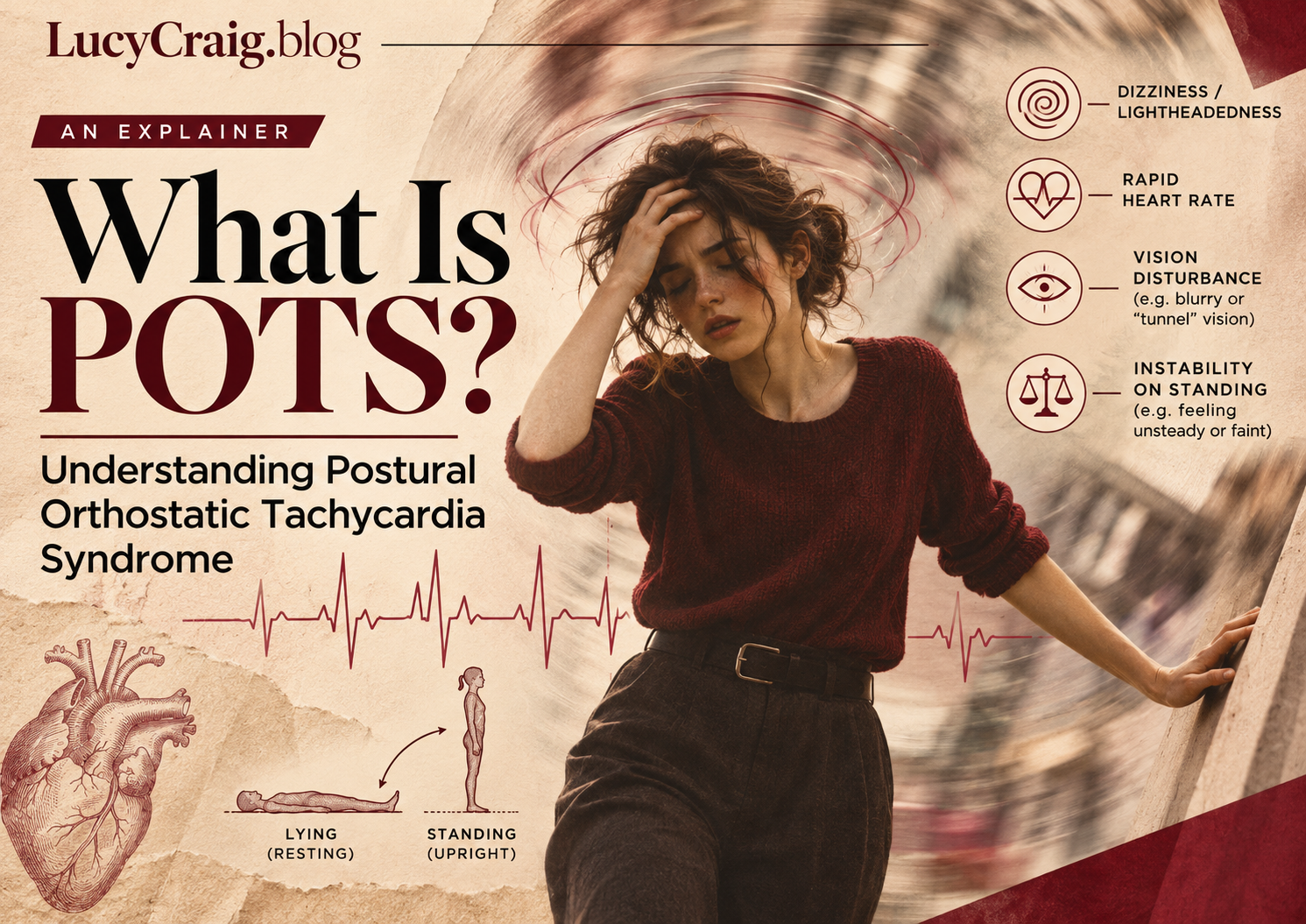
Common symptoms include:
Dizziness or lightheadedness.
Racing or pounding heartbeat.
Blurred or tunnel vision.
Weakness and fatigue.
Difficulty concentrating, commonly called brain fog.
Nausea, headaches, or shakiness.
Feeling faint, and sometimes actually fainting.
Symptoms vary enormously. Some people experience mild inconvenience; others face significant limitations in daily life.
And yes, some patients may become dizzy simply by standing up.
No gym membership required.
Alcohol: Not Always the Life of the Party
Alcohol deserves particular attention because Craig references her reported POTS diagnosis in connection with drinking.
Alcohol can widen blood vessels and contribute to dehydration, both of which may aggravate symptoms in people with POTS.
This means drinking can be particularly uncomfortable for some patients, potentially increasing lightheadedness, a racing heart, or difficulty remaining upright.
Of course, dizziness after drinking alcohol is hardly a phenomenon exclusive to people with POTS.
The distinction matters medically.
POTS-related dizziness and alcohol intoxication can produce overlapping symptoms, but they are not the same condition. POTS also does not establish a person's blood alcohol concentration or how much alcohol they consumed.
There is no medical calculator where you enter three cocktails, a POTS diagnosis, and someone's shoe size to receive an accurate reconstruction of their physical condition.
Human physiology is inconveniently more complicated than that.
What About Sex, Physical Exertion, and Multiple Partners?
Now for an aspect of physical activity that medical brochures do not always discuss in particularly entertaining language.
Sexual activity can involve increased heart rate, changes in body position, muscular exertion, sweating, and elevated body temperature.
These are all ordinary physiological responses to physical activity.
For individuals with POTS, some of those factors may aggravate symptoms, just as certain kinds of exercise, prolonged standing, or exposure to heat can do.
Does that mean sex itself is medically prohibited for people with POTS?
No.
Does it mean every person with POTS experiences dizziness during sexual activity?
Also no.
And what about sexual activity involving multiple partners?
Here medical science becomes considerably less sensational than the question.
There is no established medical rule that the number of sexual partners independently determines the severity of someone's POTS symptoms.
What may matter is the physical activity, exertion, heat, hydration, and changes in posture involved.
The autonomic nervous system does not appear to maintain a guest list.
One person, two people, or a room full of people: the relevant physiological questions remain those involving heart rate, circulation, body positioning, and individual symptoms.
A person's diagnosis cannot be confirmed or rejected by counting the number of people participating in an activity.
That may disappoint anyone hoping for a simple mathematical formula, but cardiology is not a spectator sport.
And none of this establishes what symptoms any particular person experienced during an incident.
Why Vision and Balance Can Become Problems
Craig's reference to vision and balance difficulties is also worth explaining.
When the body struggles to regulate circulation while upright, an individual can experience lightheadedness and temporary visual disturbances.
Some people describe blurred vision, tunnel vision, or a sensation that they are about to faint.
Others feel physically unsteady.
It is important to distinguish this from a primary inner-ear balance disorder. In POTS, these symptoms are commonly linked to orthostatic intolerance and circulatory regulation.
For some patients, relief comes from sitting or lying down.
In other words, the body may communicate a relatively simple message: standing was apparently too ambitious; please return to a horizontal position.
Can POTS Affect Thinking and Memory?
POTS can also produce cognitive difficulties commonly referred to as brain fog.
Patients may experience slower thinking, trouble concentrating, or difficulty with working memory.
The description is informal, but the symptoms are recognized in medical research.
However, a crucial distinction exists between brain fog and complete memory loss.
POTS does not automatically explain blackouts, unconsciousness, prolonged memory gaps, or an inability to recall a particular event.
Those experiences may have multiple causes requiring individual medical assessment.
A POTS diagnosis alone does not establish what anyone was thinking, remembering, understanding, or experiencing at a particular moment.
Medical science, unfortunately for fans of absolute answers, insists on evidence.
How Would a Doctor Actually Diagnose POTS?
Doctors don't diagnose POTS merely because someone becomes dizzy.
For adults, a common diagnostic benchmark is an increase in heart rate of at least 30 beats per minute within 10 minutes of standing, without a significant drop in blood pressure.
Doctors also evaluate persistent symptoms, typically present for at least three months, and investigate other potential explanations.
Testing may include a standing heart-rate assessment or a tilt-table test.
Dehydration, anemia, medication effects, and other conditions must also be considered.
In other words, a medical diagnosis involves more than someone reporting that they felt dizzy.
The same principle works in reverse: someone who can walk, dance, exercise, or engage in sexual activity is not thereby proven incapable of having POTS.
Symptoms fluctuate, and individuals differ.
Can Someone With POTS Live a Normal Life?
Absolutely, although the degree of limitation differs from person to person.
People with POTS can attend college, maintain relationships, work, socialize, travel, exercise, and participate in sexual activity.
Some require substantial accommodations or treatment to do these things comfortably.
Management may involve hydration, appropriate sodium intake, compression garments, structured exercise, medications, and avoiding individually identified triggers.
There is no universal treatment plan and no guarantee that every patient will experience the same limitations.
Having POTS does not mean someone must remain permanently seated, avoid social gatherings, or retire from all recreational activity.
It means their autonomic nervous system may require more careful management than most.
The Bottom Line
POTS is a recognized medical disorder with potentially serious effects on circulation, heart rate, stamina, and daily functioning.
Dizziness, visual disturbances, weakness, and problems tolerating an upright posture are among its established symptoms.
Alcohol, dehydration, heat, and physical exertion can aggravate symptoms in some patients. Sexual activity can involve some of those same physical demands.
But neither sexual activity nor the number of people involved in it is a diagnostic test for POTS.
Lucy Craig references the condition in her police statement, making it reasonable to explain the medical terminology for readers trying to understand the document.
What that medical information does not do is independently verify her diagnosis, establish the cause of any particular symptom, or determine the truth of the events described.
That distinction is essential.
POTS may make ordinary activities unexpectedly difficult. Understanding why requires medicine, not assumptions.
And although standing up may occasionally feel like an Olympic event for someone with POTS, the medical profession has not yet introduced a scoring category for how crowded the bedroom happens to be.
Sources and Further Reading
Johns Hopkins Medicine: Postural Orthostatic Tachycardia Syndrome
National Institutes of Health: Recognizing POTS
Cleveland Clinic: POTS
NHS: Postural Tachycardia Syndrome
Primary document: Lucile H. Craig, Voluntary Statement, Cornell University Police Department, case 24-28167, six pages, specifically pages 1 and 5.
-Chief Justice William Rehnquist, majority opinion, 485 U.S. at 55.